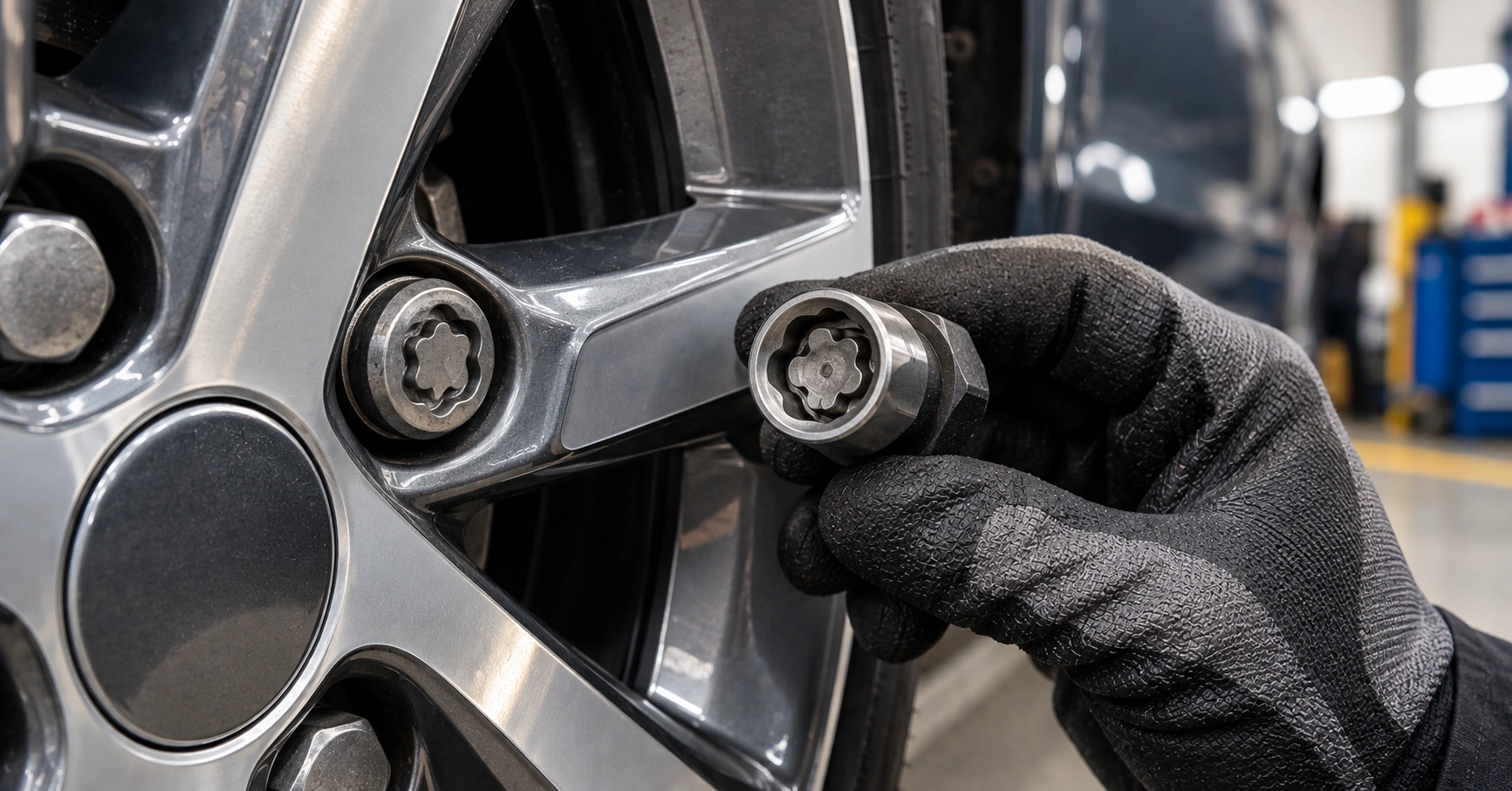
Without the key, the wheel can’t come off. A locking wheel nut has a patterned end that only its matching key fits, so a tyre can’t be changed or a puncture repaired until the key is found or the nut is removed another way.
Three things to do, in order:
- Search the car properly. These keys are small and are often stored somewhere you wouldn’t think to look.
- Order a replacement using the key code, if you can find the code.
- Have the nut removed professionally if the key is gone for good.
Don’t attempt to hammer a socket onto a locking nut. It usually damages the alloy wheel, and can leave the nut harder to remove than before.
First: check these places
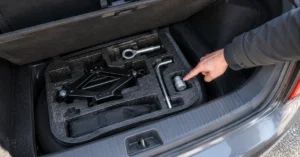
The key is usually a short socket-shaped adapter, sometimes with a plastic collar around it. Look in:
- The glovebox, including any pouch or the owner’s manual wallet
- The storage tray under the boot floor, with the jack and wheel brace
- The spare wheel well, or beside the sealant kit if there’s no spare
- A foam tool tray in the boot, where it may sit in a cut-out
- Door pockets and the centre console
- Under the front seats
- The tool roll in the boot side panel
If you bought the car used, it may never have been handed over. Ask the seller or the supplying dealer.
If the car has just been serviced or had tyres fitted, ring the garage. Keys are often left behind on the bench or in the workshop.
Find the key code and order a replacement
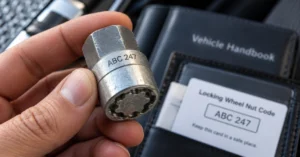
Most locking wheel nut sets have a code that identifies the exact key pattern. Once you have it, a replacement can be ordered.
Where the code is usually recorded:
| Where to look | What you’ll find |
|---|---|
| The plastic collar on the key itself | A number stamped or printed on it. No use if the key is lost, but worth knowing for next time. |
| A card or key fob in the handbook wallet | Many manufacturers supply a code card with the car |
| The vehicle handbook or service book | The code is sometimes written in |
| The main dealer | Using your registration or VIN, a franchised dealer for your make can often look up the code supplied with the car |
| The locking nut brand | If you know the brand, its customer service can advise what’s needed |
A replacement key is usually far cheaper than removing the nuts, so it’s worth trying this route first if the car isn’t urgently needed.
Ordering takes time. If your car is off the road with a flat tyre, professional removal is usually the quicker option.
If the key is gone: professional removal
Specialist tools grip the outside of a locking nut so it can be turned off without the key. Done correctly, this removes the nut without damaging the wheel.
Afterwards, you’ll need replacement nuts. Once a locking nut has been removed this way, it isn’t reusable. You can fit standard wheel nuts or a new locking set with a new key.
Why not to force it yourself
Common DIY attempts and what usually happens:
| Attempt | Likely result |
|---|---|
| Hammering a slightly undersized socket on | The socket jams on the nut, the alloy face gets marked, and the nut is now harder to grip properly |
| Using an impact wrench on a partly fitting socket | Rounds off the nut’s pattern, removing what the proper tool needs to grip |
| Levering with a screwdriver and hammer | Damages the wheel and the nut, and risks injury |
| Heating the nut | Can damage the wheel finish and nearby components |
There’s also a torque issue. Wheel nuts need to be tightened to the manufacturer’s setting. Nuts that have been damaged or improvised can’t be relied on to hold the correct torque.
What it means for a mobile tyre visit
If a tyre needs changing or repairing, the wheel has to come off. So the locking wheel nut key matters as much as the tyre size.
When you call, say whether you have it. If you’re not sure, check before the fitter arrives. Our checklist before calling a mobile tyre fitter covers the other details worth having ready.
If you have no spare wheel and no key, the tyre can’t be changed until the nut comes off. See no spare wheel? Your options after a puncture.
On a motorway, this isn’t the problem to solve at the roadside. Get to a safe place first. See mobile tyre fitter vs breakdown cover vs garage.
Avoiding the problem next time
- Keep the key with the jack and wheel brace, not loose in the glovebox where it can be tidied away.
- Photograph the code on the key collar and save it to your phone.
- Check it’s returned after any garage visit, tyre fitting or MOT.
- Consider standard nuts if locking nuts aren’t important to you. They’re less of a theft deterrent, but there’s nothing to lose.
- If you’re buying a used car, ask for the locking wheel nut key before you hand over the money.
Frequently asked questions
Can a locking wheel nut be removed without the key?
Yes. Specialist removal tools grip the outside of the nut so it can be turned off. The nut is destroyed in the process and needs replacing, but the wheel isn’t damaged when it’s done with the right tools.
Where do I find my locking wheel nut key code?
It’s often stamped on the plastic collar of the key, printed on a card in the handbook wallet, or recorded in the service book. A franchised dealer for your make can sometimes look it up from the vehicle’s registration or VIN.
How much does it cost to remove a locking wheel nut?
It varies with the type of nut and how badly it’s damaged. A replacement key ordered from a dealer is usually cheaper than removal, if you can wait for it to arrive.
Can I still drive with a locking wheel nut I can’t remove?
Yes, as long as the wheels are secure and the tyres are sound. The problem only arises when a wheel has to come off, which is why it’s worth sorting before you get a puncture.
Will a mobile tyre fitter come out if I’ve lost the key?
Say so when you book. Whether the nut can be dealt with at your location depends on the tools needed, so it’s better to raise it up front than to find out when the fitter arrives.
Need a tyre changed? Check for your locking wheel nut key first, then call 07415955827 about mobile tyre fitting at your home or work.