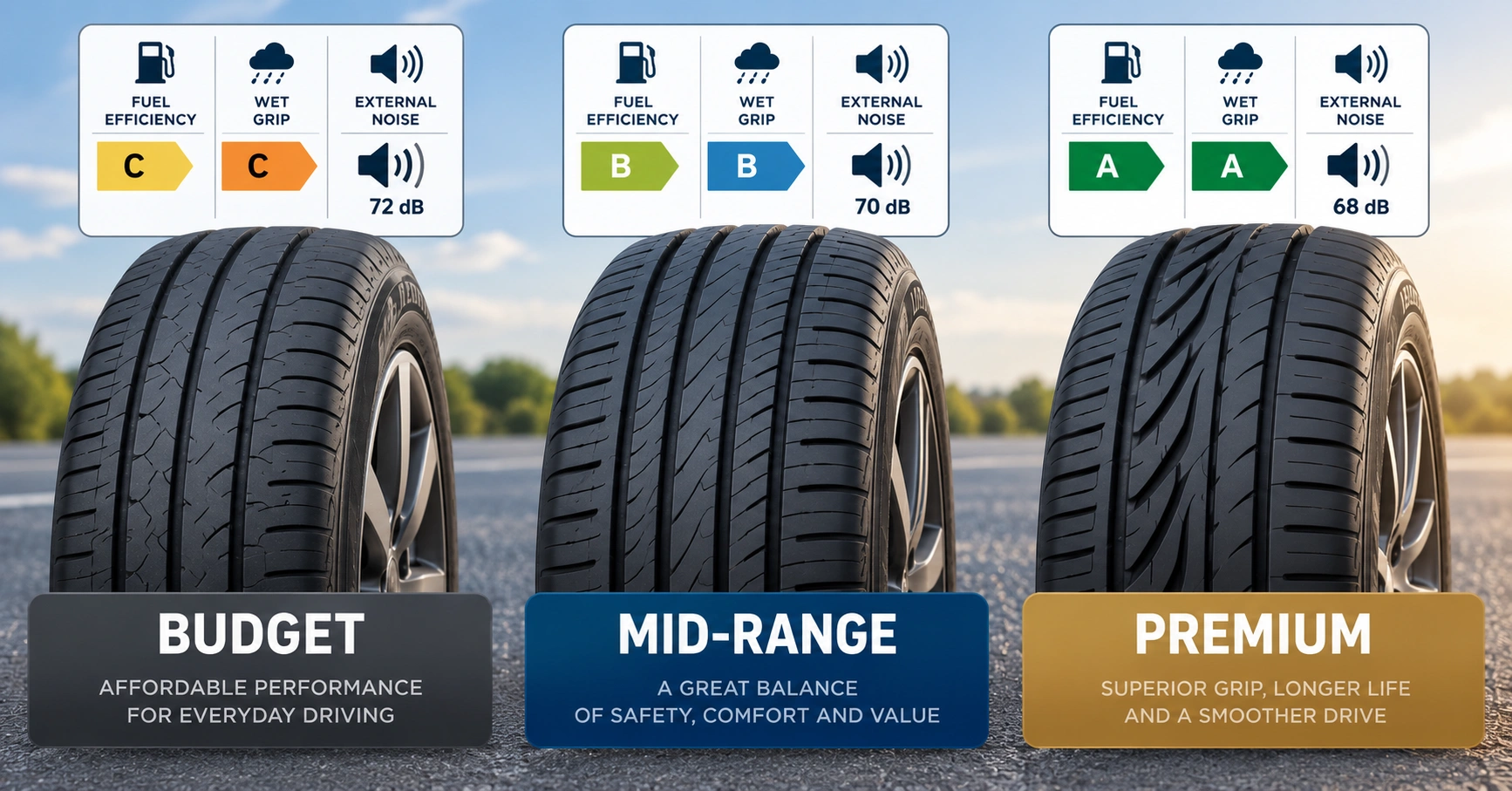
When you need a new tyre, you’ll usually be offered three broad choices:
- Budget tyres
- Mid-range tyres
- Premium tyres
All new road-legal tyres sold for use in the UK have to meet the required safety standards. Paying more doesn’t simply mean one tyre is “safe” and another is “unsafe”.
The differences are more about performance.
Wet braking, road noise, rolling resistance, tread life and how consistently the tyre performs as it wears can all vary between models and price tiers.
The best choice depends on your car, mileage, driving conditions and budget.
Budget vs Mid-Range vs Premium Tyres at a Glance
| Tyre Tier | What You Typically Get | Often Suits |
|---|---|---|
| Budget | Lower purchase price and basic everyday performance | Lower-mileage cars, local driving and tighter budgets |
| Mid-range | Balance between price, performance and brand development | Mixed everyday driving and drivers looking for a middle ground |
| Premium | Greater investment in tyre technology, testing and performance | Higher mileage, motorway use, performance cars and drivers prioritising wet grip, refinement or longevity |
The tier alone doesn’t tell you everything.
Two tyres in the same price category can have different wet-grip, efficiency and noise ratings, so compare the actual tyre rather than relying only on the brand name or price.
What Is a Budget Tyre?
Budget tyres are generally produced to offer a lower purchase price.
They still need to meet the legal requirements for new tyres sold in the UK, but they may use different compounds, tread designs and manufacturing technologies compared with more expensive models.
A budget tyre can make sense if:
- You do relatively low annual mileage
- Most journeys are short and local
- You drive a modest car
- Keeping the initial replacement cost down is important
- You don’t need specialist performance characteristics
Price shouldn’t be the only thing you check.
Look at the tyre’s label ratings and make sure the size, load index and speed rating are appropriate for your vehicle.
What Is a Mid-Range Tyre?
Mid-range tyres sit between budget and premium options.
They can offer a useful balance of:
- Purchase price
- Wet-weather performance
- Noise
- Tread life
- Rolling resistance
- Everyday driving characteristics
They may suit drivers who cover a mixture of town, A-road and motorway miles but don’t necessarily need or want to pay for a premium tyre.
For many drivers, the decision isn’t simply “cheap or expensive”. A mid-range tyre gives another option between the two.
What Is a Premium Tyre?
Premium tyres are generally produced by manufacturers that invest heavily in research, development and testing.
Depending on the individual tyre model, the benefits can include:
- Stronger wet braking performance
- Better handling
- Lower road noise
- Improved rolling resistance
- Better performance as the tyre wears
- Longer useful tread life in some applications
That doesn’t mean every driver automatically needs the most expensive tyre available.
The value of those characteristics depends on how and where the vehicle is used.
Understanding the UK Tyre Label
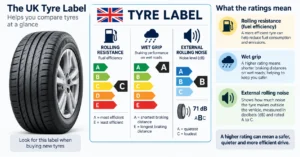
New tyres are supplied with standardised label information that makes certain characteristics easier to compare.
The main ratings include:
Wet Grip
Wet grip is graded from A to E.
This rating helps compare braking performance on wet roads.
For a driver doing regular motorway and high-speed road journeys, wet braking performance can be an important part of choosing between tyre options.
Fuel Efficiency / Rolling Resistance
Rolling resistance is also graded from A to E.
A tyre with lower rolling resistance requires less energy to keep moving, which can contribute to fuel or energy efficiency.
External Rolling Noise
The label also shows external rolling noise in decibels (dB) along with a noise class.
This gives you a standardised way to compare the external noise generated by different tyres.
Snow and Ice Markings
Where applicable, the label can also show additional information relating to snow or severe winter conditions.
What Doesn’t the Tyre Label Tell You?
The tyre label is useful, but it doesn’t describe every part of tyre performance.
It doesn’t give you a complete picture of:
- Dry handling
- Aquaplaning resistance
- Tread life
- Performance as the tyre wears
- Ride comfort
- Steering feel
- Durability over potholes and rough roads
That’s why price and label ratings should be considered alongside your actual driving needs.
Where Do Budget and Premium Tyres Differ Most?
1. Wet Braking
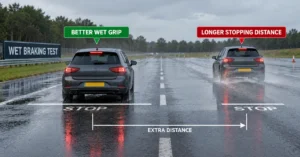
Wet-weather performance is one of the easiest characteristics to compare because the tyre label provides a wet-grip grade.
If you regularly drive long distances in poor weather, this may carry more weight in your decision than it would for a low-mileage local car.
2. Tread Life
A cheaper tyre isn’t necessarily cheaper over its whole life.
If one tyre wears significantly faster than another, the initial saving may be reduced because it needs replacing sooner.
At the same time, tyre life depends heavily on:
- Driving style
- Tyre pressure
- Wheel alignment
- Vehicle weight
- Road conditions
- Mileage and journey type
Price alone can’t tell you exactly how long a tyre will last.
3. Performance as the Tyre Wears
A tyre doesn’t remain new for long.
Its characteristics change as the tread wears.
Tyre design and compound can affect how consistently it performs through its usable life.
4. Road Noise and Comfort
Noise can matter more if you spend several hours each week on motorways.
For a car used mainly for short urban journeys, the difference may be less important to you.
5. Fuel or Energy Efficiency
Rolling resistance affects how much energy is needed to move the vehicle.
This matters for both fuel-powered cars and electric vehicles.
Which Tyre Tier Suits Your Driving?
| Your Driving | What to Consider |
|---|---|
| Low-mileage local driving | A suitable budget or mid-range tyre may meet your needs |
| Mixed town and motorway use | Compare mid-range and premium options on wet grip, noise and overall value |
| High annual mileage | Tread life, wet performance and rolling resistance become more important |
| Regular motorway driving | Wet grip, stability, noise and performance over longer journeys matter |
| Performance car | Use tyres with the correct specification and performance capability |
| Electric vehicle | Vehicle weight, load rating, efficiency and manufacturer requirements should be considered |
| Van or heavier vehicle | Correct load capacity is particularly important |
Always Match the Correct Tyre Specification
Price tier comes after specification.
Before deciding between budget, mid-range and premium, make sure the tyre is suitable for the vehicle.
Check:
- Tyre width
- Profile
- Wheel diameter
- Load index
- Speed rating
- XL or reinforced specification where required
- Run-flat construction where applicable
For example, a sidewall might show:
205/55 R16 91V
Our guide on how to read a tyre sidewall explains what each number and letter means.
A cheaper tyre with the wrong specification isn’t a suitable substitute for the correct tyre.
Should You Use the Same Tyres on the Same Axle?
When replacing a single tyre, consider the tyre already fitted to the other side of the axle.
Check:
- Size
- Construction
- Load rating
- Speed rating
- Tread depth
- Overall condition
- Tyre type
Large differences between tyres on the same axle can affect the way the vehicle behaves.
If you’re unsure, ask what replacement options are suitable before choosing solely on price.
Are Part-Worn Tyres Better Than New Budget Tyres?
A used premium tyre and a new budget tyre aren’t directly comparable simply because one carries a more expensive brand name.
With a part-worn tyre, you also need to consider:
- Its remaining tread
- Its age
- Previous use
- Previous repairs
- Damage
- How it was stored
The condition and history of a used tyre matter as much as the name printed on its sidewall.
Is a Premium Tyre Worth It?
That depends on what you’re paying extra for and whether those characteristics matter to your driving.
Premium tyres may be more attractive if you:
- Cover high annual mileage
- Spend a lot of time on motorways
- Regularly drive in wet conditions
- Own a higher-performance vehicle
- Prioritise refinement and road noise
- Want to compare higher-performing tyre models
A budget or mid-range tyre may make more sense if:
- Your mileage is low
- Most journeys are local
- The vehicle has modest performance requirements
- Your budget is the main constraint
Rather than choosing by category alone, compare the actual tyres available in your required size.
Don’t Compare Quotes Without Comparing the Tyre
Two tyre fitting quotes can be very different because they include completely different tyres.
Before comparing prices, ask for:
- Brand
- Tyre model
- Full tyre size
- Load index
- Speed rating
- Whether it’s XL/reinforced if required
- Whether fitting and balancing are included
- Whether the valve is included
- Whether old tyre disposal is included
- Whether there’s a call-out or travel charge
Our guide to mobile tyre fitting costs explains what can affect the total price.
Frequently Asked Questions
Are Budget Tyres Safe?
New road-legal tyres sold for UK road use must meet the applicable legal requirements. However, performance characteristics such as wet grip, noise, rolling resistance and durability can differ between individual tyre models.
Are Premium Tyres Always Better?
Not in every way that matters to every driver. Premium models may offer stronger performance in particular areas, but the right choice depends on your vehicle, driving conditions, mileage and budget.
Are Mid-Range Tyres Worth Buying?
They can provide a balance between purchase price and performance. Compare the specific tyre’s label ratings and specification rather than choosing based on category alone.
Should I Put Premium Tyres on an Older Car?
The age of the car alone doesn’t decide which tyre tier is appropriate. Consider the correct tyre specification, mileage, type of driving and the performance characteristics you value.
What Matters More: Tyre Brand or Tyre Label?
Both can provide useful information, but neither should be used alone. The tyre label allows certain characteristics to be compared directly, while the exact tyre specification and your driving requirements also matter.
Can I Mix Budget and Premium Tyres?
The specification and condition of tyres on the same axle should be considered carefully. When replacing one tyre, check what is already fitted and make sure the replacement is suitable for the vehicle.
Need Replacement Tyres in Reading?
If you need a replacement tyre, call 07415955827 with the full tyre size from your sidewall.
Before choosing, you can ask about the available budget, mid-range and premium options in your required size.
For more information, see our mobile tyre replacement service.