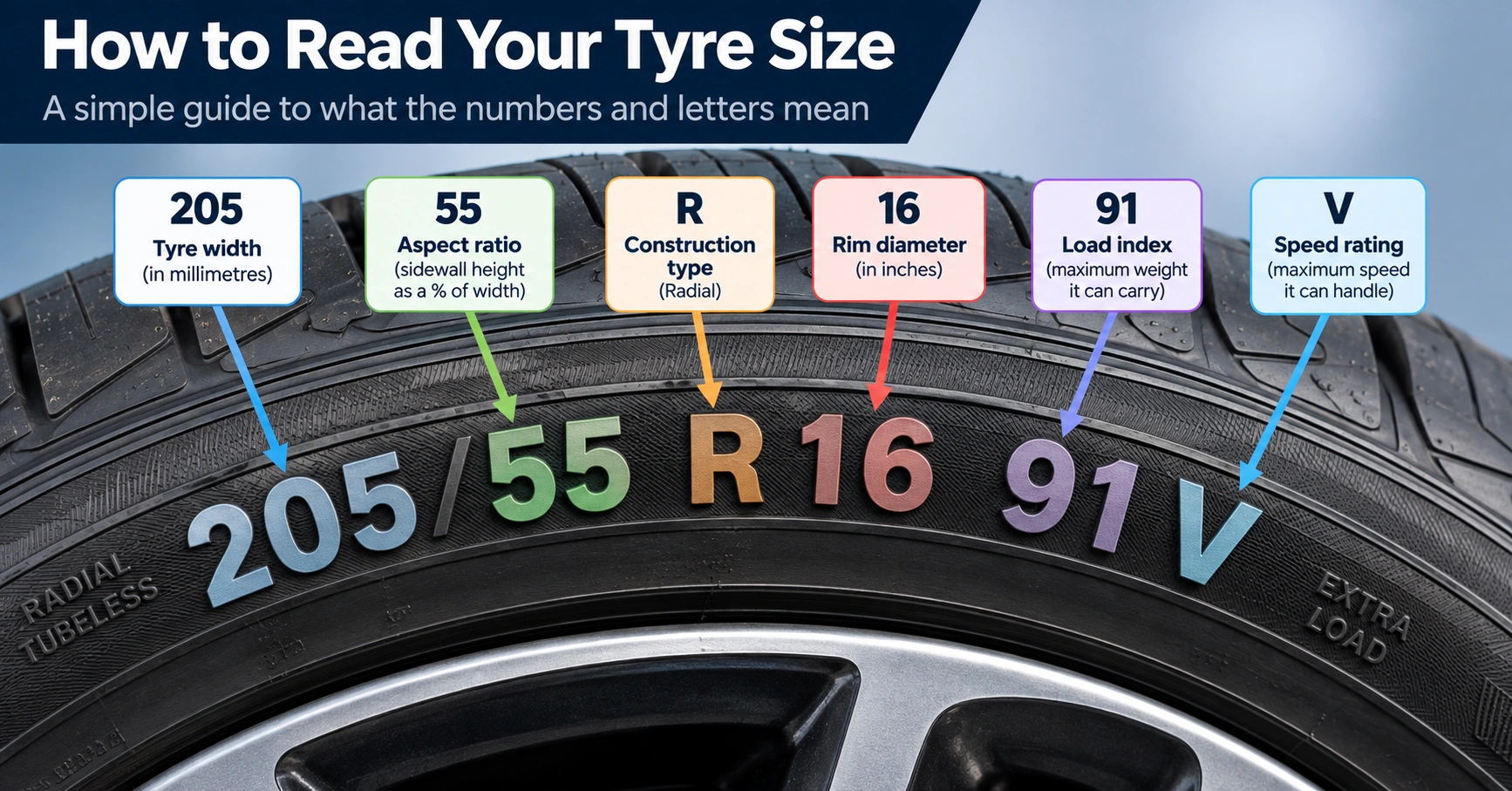
A tyre sidewall contains almost everything you need to identify the correct replacement tyre.
A typical code looks like this:
205/55 R16 91V
Those numbers and letters tell you the tyre’s:
- Width
- Profile
- Construction
- Wheel diameter
- Load rating
- Speed rating
You’ll also find markings for tyre age, reinforced construction, winter capability, run-flat technology and other specifications.
Knowing what they mean makes it much easier to get the correct tyre when you need a replacement.
What Does 205/55 R16 91V Mean?
| Marking | Example | Meaning |
|---|---|---|
| Width | 205 | Width of the tyre in millimetres |
| Profile | 55 | Sidewall height as a percentage of the tyre width |
| Construction | R | Radial construction |
| Wheel diameter | 16 | Diameter of the wheel rim in inches |
| Load index | 91 | Maximum load the tyre is rated to carry |
| Speed rating | V | Maximum rated speed of the tyre |
When asking for a replacement tyre, give the full code, not just the wheel diameter.
Where Do You Find the Tyre Size?
Look at the outer sidewall of your tyre.
You’ll see several groups of numbers, letters and symbols.
The main size normally appears prominently and looks similar to:
195/65 R15 91H
or
225/40 R18 92Y XL
If you’re calling a tyre fitter and aren’t sure which code they need, take a clear photo of the sidewall.
1. Tyre Width
In:
205/55 R16 91V
the 205 is the nominal tyre width in millimetres.
So this tyre is approximately 205mm wide.
A wider tyre isn’t automatically better. Your car is designed to use specific approved sizes.
2. Tyre Profile
The 55 is the aspect ratio or profile.
It means the sidewall height is 55% of the tyre’s width.
This isn’t a measurement in millimetres.
Lower-profile tyres have shorter sidewalls relative to their width.
For example:
- 205/55 R16
- 205/45 R17
The second tyre has a lower profile even though both are 205mm wide.
3. What Does the R Mean?
The R means radial construction.
Most modern passenger car tyres use radial construction.
It isn’t the radius of the wheel.
4. Wheel Diameter
The 16 tells you the tyre is designed for a 16-inch wheel.
This is why saying “I need a 16-inch tyre” isn’t enough.
There are many different tyre widths and profiles designed for 16-inch wheels.
The complete size code is required.
5. Load Index
The number after the wheel diameter is the load index.
In:
205/55 R16 91V
the load index is 91.
The number corresponds to a maximum load capacity.
Here are some common examples:
| Load Index | Maximum Load Per Tyre |
|---|---|
| 84 | 500 kg |
| 85 | 515 kg |
| 86 | 530 kg |
| 87 | 545 kg |
| 88 | 560 kg |
| 89 | 580 kg |
| 90 | 600 kg |
| 91 | 615 kg |
| 92 | 630 kg |
| 93 | 650 kg |
| 94 | 670 kg |
| 95 | 690 kg |
| 96 | 710 kg |
| 97 | 730 kg |
| 98 | 750 kg |
| 99 | 775 kg |
| 100 | 800 kg |
| 101 | 825 kg |
| 102 | 850 kg |
| 103 | 875 kg |
Don’t fit a tyre with an unsuitable load rating simply because the physical size matches.
6. Speed Rating
The final letter is the tyre’s speed rating.
In our example:
205/55 R16 91V
the speed rating is V.
Common ratings include:
| Rating | Maximum Rated Speed |
|---|---|
| Q | 99 mph |
| R | 106 mph |
| S | 112 mph |
| T | 118 mph |
| H | 130 mph |
| V | 149 mph |
| W | 168 mph |
| Y | 186 mph |
The correct speed rating forms part of choosing a tyre suitable for your vehicle.
How Do You Check the Age of a Tyre?
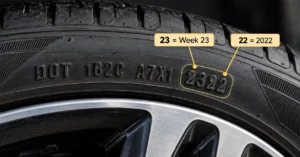
Look for the tyre’s date code.
The final four digits identify the week and year of manufacture.
For example:
2322
means the tyre was manufactured in:
- Week 23
- 2022
The date code may only appear on one side of the tyre.
Is There a Legal Maximum Age for Car Tyres?
For ordinary passenger cars, there isn’t a general legal maximum tyre age simply based on the date code.
However, tyre condition changes with age, storage, heat, sunlight and use.
Manufacturers commonly recommend increased inspection as tyres become older, with replacement often advised around ten years from manufacture even when tread remains.
There are separate age restrictions applying to certain tyres on heavy vehicles.
Tyre age should therefore be considered alongside:
- Cracking
- Perishing
- Bulges
- Tread condition
- Previous repairs
- How the tyre has been stored and used
Other Common Tyre Sidewall Markings
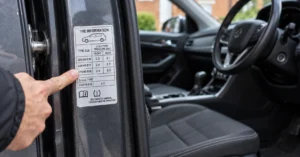
| Marking | Meaning |
|---|---|
| XL | Extra Load / reinforced tyre |
| Reinforced | Designed for a higher load than a standard equivalent |
| RFT / run-flat marking | Run-flat construction, depending on manufacturer |
| M+S | Mud and Snow marking |
| 3PMSF | Three-Peak Mountain Snowflake winter-performance marking |
| OEM markings | Some tyres carry markings showing approval for specific vehicle manufacturers |
| TWI | Tread Wear Indicator location |
| Rotation arrow | Shows required direction for directional tyres |
| Outside / Inside | Indicates correct mounting orientation on asymmetric tyres |
| Max pressure | Tyre’s maximum pressure marking, not necessarily your car’s recommended operating pressure |
If your vehicle uses run-flat tyres, it’s especially useful to know because many cars with run-flats don’t carry a spare. See what to do if your car has no spare wheel.
What Does XL Mean on a Tyre?
XL stands for Extra Load.
An XL tyre is designed to carry a higher load at the specified pressure than the equivalent standard-load version.
Don’t assume XL means an oversized tyre.
The physical size can be exactly the same as a non-XL tyre.
If your vehicle specifies XL tyres, that specification matters when choosing a replacement.
What Do Run-Flat Markings Mean?
Run-flat tyres have reinforced construction designed to support the vehicle for a limited distance after pressure loss.
Different manufacturers use different markings.
If you’re unsure whether your current tyre is a run-flat, check:
- The tyre sidewall
- Vehicle handbook
- Manufacturer specification
Don’t replace a run-flat with a standard tyre without understanding how that affects the vehicle setup and what emergency equipment you’ll need.
Which Numbers Matter When Buying a Replacement Tyre?
At minimum, check:
| Specification | Why It Matters |
|---|---|
| Width/profile/rim size | Determines physical tyre size |
| Load index | Ensures sufficient load capacity |
| Speed rating | Ensures appropriate performance specification |
| XL/reinforced marking | Important where specified for the vehicle |
| Run-flat construction | Important if the vehicle is designed around run-flat tyres |
You can then decide which brand tier suits your driving and budget.
See budget vs mid-range vs premium tyres for help comparing your options.
Tyre size and type also affect the final fitting price. Our guide to mobile tyre fitting costs explains the main pricing factors.
Can Front and Rear Tyre Sizes Be Different?
Yes.
Some vehicles use a staggered setup, meaning the front and rear tyres have different widths or sizes.
Don’t assume the size printed on one tyre automatically applies to all four wheels.
Check the tyre that actually needs replacing.
Frequently Asked Questions
Where Is My Tyre Size Written?
It’s printed on the tyre sidewall. Look for a code similar to 205/55 R16 91V.
What Does 205/55 R16 Mean?
205 is the tyre width in millimetres, 55 is the sidewall profile as a percentage of the width, R means radial construction, and 16 is the wheel diameter in inches.
What Does 91V Mean on a Tyre?
91 is the load index and V is the speed rating.
How Can I Tell How Old My Tyre Is?
Find the four-digit date code. For example, 2322 means the tyre was manufactured in week 23 of 2022.
Can I Send a Photo Instead of Reading the Tyre Size?
Yes. A clear photo of the tyre sidewall showing the complete size and rating is a simple way to provide the information accurately.
Need the Correct Replacement Tyre in Reading?
If you need a replacement tyre, call 07415955827 and provide the full size code from the tyre sidewall.
You can also see our mobile tyre replacement service for more information.