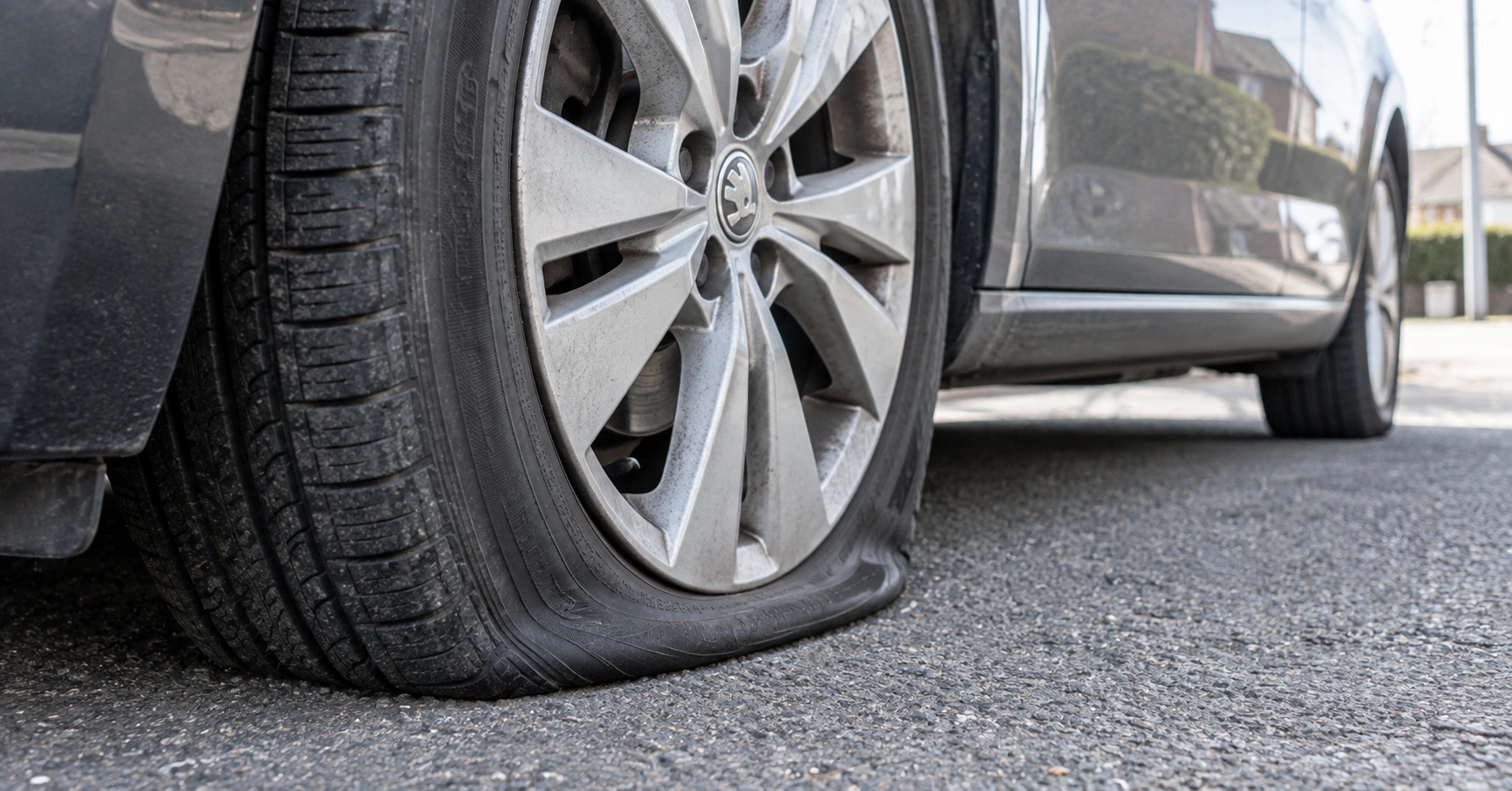
In most cases, you shouldn’t drive on a flat tyre.
The exception is when moving the vehicle a very short distance is necessary to get out of immediate danger, or when your car has approved run-flat tyres and you’re following the manufacturer’s restrictions.
Driving on a standard flat tyre can destroy the tyre, damage the wheel and affect your ability to control the car.
A puncture that might have been repairable can also become a replacement once the tyre has been driven without enough air.
What Happens When You Drive on a Flat Tyre?
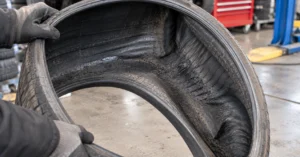
A tyre needs air pressure to support the vehicle and maintain its shape.
When the pressure disappears, the sidewall is crushed between the road and the wheel.
| Possible Damage | What Happens |
|---|---|
| Sidewall damage | The sidewall flexes and is crushed under the vehicle’s weight |
| Internal tyre damage | Structural damage can develop where you can’t see it |
| Wheel damage | The rim can contact the road surface |
| Handling problems | Steering, braking and stability can be affected |
| Repairable puncture becomes unrepairable | Continued driving can damage an otherwise usable tyre |
This is why the outside appearance alone isn’t enough to decide whether a flat tyre can be repaired.
Is It Illegal to Drive on a Flat Tyre?
Tyres used on UK roads must meet legal requirements and be in a condition suitable for use.
Driving with a defective tyre can result in a fine of up to £2,500 and three penalty points per tyre.
More importantly, a flat tyre can seriously affect steering, braking and vehicle stability.
If a tyre is visibly flat or badly damaged, don’t continue a normal journey.
What Should You Do in Different Situations?
| Situation | What to Do |
|---|---|
| Flat tyre on your driveway | Leave the car parked and arrange repair/replacement |
| Flat tyre in a safe car park | Don’t drive away on it; arrange assistance |
| Pressure warning but tyre still inflated | Stop somewhere safe and check the tyre |
| Sudden failure while driving | Slow down smoothly and stop in a safe place |
| Motorway tyre failure | Prioritise getting to a safe location and follow motorway safety guidance |
| Run-flat tyre | Follow the vehicle and tyre manufacturer’s speed/distance restrictions |
What If Your Tyre Goes Flat on a Motorway?
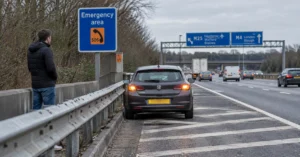
A motorway tyre failure needs to be treated differently from a puncture at home.
If possible:
- Leave the motorway at the next junction or service area.
- If you can’t leave, use an emergency area or hard shoulder where available.
- Switch on your hazard lights.
- Stop as far to the left as possible.
- If it’s safe, leave through the left-hand doors and wait behind the safety barrier.
Don’t try to change a wheel next to fast-moving motorway traffic.
If your vehicle stops in a live traffic lane and you can’t safely get out, keep your seat belt on, switch on the hazard lights and call 999.
For National Highways assistance in England, call 0300 123 5000.
For more guidance on choosing the right type of assistance, see mobile tyre fitter vs breakdown cover vs garage.
What If the Tyre Fails Suddenly While You’re Driving?
If you experience a sudden tyre failure:
- Keep a firm grip on the steering wheel.
- Avoid sudden steering movements.
- Ease off the accelerator.
- Avoid harsh braking where possible.
- Allow the vehicle to slow down.
- Move to a safe place when you can.
Once safely stopped, inspect the situation without putting yourself in danger.
Don’t continue driving simply to reach home or a garage if the tyre is flat.
What If the Tyre Is Low but Not Completely Flat?
A low tyre isn’t the same as a completely flat tyre, but it still needs attention.
Signs can include:
- TPMS warning light
- Steering feeling different
- Vehicle pulling to one side
- Visible reduction in tyre height
- Repeated need to add air
- Hissing from the tyre
Stop somewhere safe and check the tyre.
If there’s a nail or screw in the tread, leave it in place and read what to do if you find a nail or screw in your tyre.
Don’t keep topping the tyre up indefinitely without finding out why it’s losing pressure.
What About Run-Flat Tyres?
Run-flat tyres are specifically designed to support the vehicle for a limited distance after pressure loss.
They are different from standard tyres.
If your car has run-flats:
- Check the vehicle handbook
- Follow the manufacturer’s maximum speed
- Follow the permitted distance limit
- Arrange an inspection as soon as possible
Run-flat doesn’t mean “drive normally with no air.”
The tyre can still be damaged and may need replacing after being driven without normal pressure.
What Are Your Options Once You’ve Stopped?
Call a Mobile Tyre Fitter
If the vehicle is in a safe, accessible location, a mobile fitter can inspect the tyre and determine whether repair or replacement is needed.
Fit the Spare Wheel
If your car has a spare wheel and you can fit it safely, follow the vehicle manufacturer’s instructions.
Don’t attempt a wheel change in a dangerous location.
Use the Tyre Sealant Kit
If your vehicle has no spare, it may have a temporary sealant and compressor kit.
These kits only work for certain types of puncture.
Read our guide on tyre sealant and puncture repair kits before using one.
Call Breakdown Recovery
If the location isn’t safe for tyre work or the vehicle has additional damage, recovery may be the right option.
If you’ve opened the boot and discovered there isn’t a spare wheel, see your options when you have no spare wheel.
Can a Flat Tyre Still Be Repaired?
Sometimes.
Whether a repair is possible depends on:
- Where the puncture is
- The size of the damage
- The condition of the tyre
- How much pressure was lost
- Whether the tyre was driven while flat
A small puncture in the permitted tread area may be repairable if the tyre hasn’t suffered internal damage.
A tyre that has been driven flat may have structural damage even when the original puncture was small.
That’s why the tyre needs to be properly inspected.
Frequently Asked Questions
Can I Drive 1 Mile on a Flat Tyre?
You shouldn’t plan to drive any normal distance on a standard flat tyre. Even a short journey can damage the tyre and wheel. Move the vehicle only if necessary for immediate safety.
Can I Drive Slowly on a Flat Tyre?
Driving slowly doesn’t remove the risk. The sidewall is still being crushed under the vehicle’s weight.
Will Driving on a Flat Ruin the Tyre?
It can. Internal sidewall damage may make a tyre unsafe to repair even if the original puncture was small.
Can I Drive on a Run-Flat Tyre With No Air?
Run-flat tyres are designed for limited use after pressure loss, but you must follow the speed and distance restrictions specified by the tyre and vehicle manufacturer.
What If I Only Have a Slow Puncture?
A slow puncture still needs investigation. Check the pressure, avoid unnecessary driving and arrange an inspection before the tyre becomes completely flat.
Got a Flat Tyre in Reading?
If your vehicle is in a safe and accessible location, call 07415955827 and have your tyre size ready.
Depending on the condition of the tyre, you may need mobile puncture repair or mobile tyre replacement.