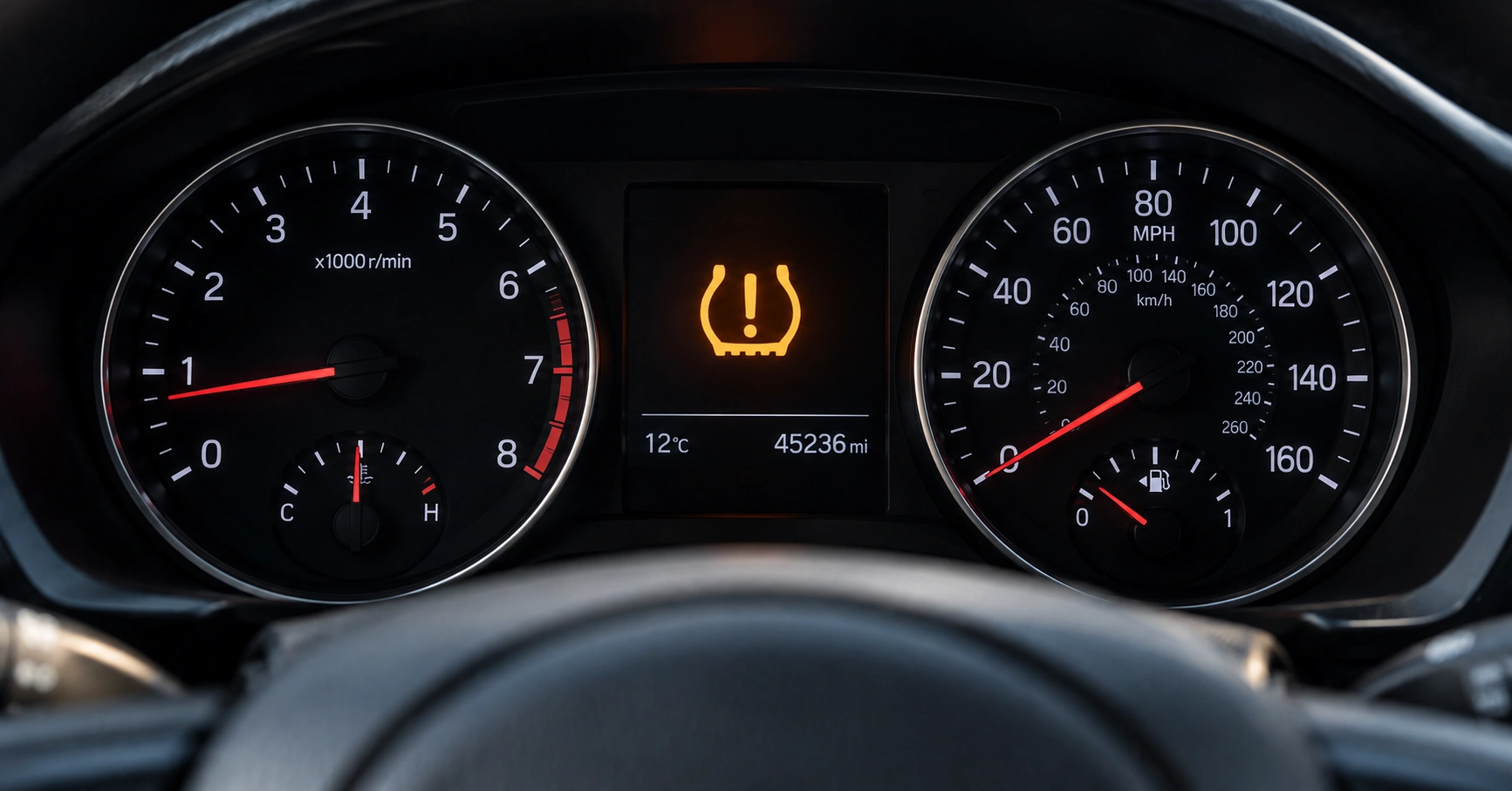
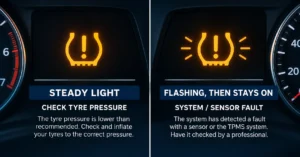
A steady tyre pressure light usually means at least one tyre has lost pressure. Check your tyres as soon as you can do so safely, and reinflate to the pressure your car specifies.
A flashing light that then stays on usually means a fault with the monitoring system itself, not necessarily low pressure. Your tyres could still be losing air, so check them anyway.
Don’t ignore either. Underinflated tyres affect braking and steering, wear faster, and can be damaged permanently by being driven on.
What the light looks like
The warning is usually an amber symbol shaped like a cross-section of a tyre with an exclamation mark inside it, sometimes described as a horseshoe or a flat-bottomed bucket. Some cars show a text message or a diagram of the car with the affected corner highlighted instead.
Steady light or flashing light?
| Light behaviour | Usual meaning | What to do |
|---|---|---|
| Comes on steady while driving | One or more tyres has lost pressure | Slow down, stop somewhere safe, check all four tyres |
| Comes on steady on a cold morning | Pressure has dropped with the temperature | Check and reinflate to the correct pressure |
| Flashes for around a minute at start-up, then stays on | A fault in the monitoring system, such as a failed sensor or a sensor not recognised | Get the system checked. Keep checking pressures manually in the meantime. |
| Comes on right after new tyres or a wheel swap | The system may need resetting, or a sensor may have been disturbed | Ask whoever fitted the tyres |
| Comes on and the car pulls or feels odd | Possible significant deflation | Stop safely. Don’t keep driving. |
What to do when the light comes on
- Reduce speed gradually and find somewhere safe to stop, away from traffic. On a motorway, follow the safety steps below.
- Look at all four tyres. An obviously flat or low tyre is easy to spot from the side.
- Check for anything stuck in the tread, such as a nail or screw. Don’t pull it out. See what to do with a nail in your tyre.
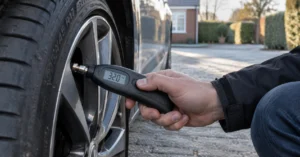
- Check the pressures with a gauge and compare them with the figures for your car. See finding the correct tyre pressure for your car.
- Reinflate to the correct pressure if you can, and drive a short distance to see whether the light goes out.
- If the tyre loses pressure again quickly, it has a leak. Have it inspected rather than repeatedly reinflating it.
Don’t drive on a flat or nearly flat tyre. Doing so damages the tyre internally and can ruin a puncture that could otherwise have been repaired. See can you drive on a flat tyre?
Why the light often comes on in cold weather
Air contracts as it cools. A drop in outside temperature lowers the pressure in your tyres without anything being wrong with them. That’s why the light often appears on the first genuinely cold morning of the autumn, on several cars at once in the same street.
What to do: check the pressures when the tyres are cold, before driving any distance, and reinflate to the figures for your car. Pressures measured after a long drive read higher because the tyres have warmed up.
If the light keeps returning as the weather warms up, you have an actual leak, not a temperature effect.
Two types of system
Understanding which one your car has explains why the light behaves as it does.
| Direct TPMS | Indirect TPMS | |
|---|---|---|
| How it works | A sensor inside each wheel measures pressure and transmits it | The ABS wheel speed sensors detect a tyre rotating slightly faster because it’s underinflated |
| Can show individual pressures | Often yes | No |
| Needs resetting after inflation | Sometimes | Usually yes, via a menu or a button |
| Parts that can fail | The sensor, its battery or the valve | Fewer tyre-specific parts |
| Affected by sealant | Yes, sealant can coat or block a sensor | Not directly |
Direct sensors have internal batteries that eventually run flat, often after several years. A sensor at the end of its life triggers a system fault warning rather than a low pressure warning.
Indirect systems can’t spot all four tyres deflating evenly, because they work by comparing wheel speeds. Regular manual pressure checks still matter.
When the light means a puncture
A leak is likely if:
- the light returns within hours or days of reinflating
- one tyre reads consistently lower than the others
- there’s an object in the tread
- you hear a hiss or see bubbles when soapy water is applied to the tread
- the tyre goes down after the car has been parked overnight
A slow puncture can take days to show up. The tyre may look normal but drift down each week.
See why tyres lose pressure for the common causes of slow and repeated pressure loss.
Pressure can also escape through:
- a damaged or corroded valve, including the valve on a TPMS sensor
- the bead, where the tyre seals against the wheel rim, particularly on a corroded alloy
- a cracked or buckled wheel after a pothole impact
These are repairs a tyre technician deals with rather than punctures in the usual sense. See mobile tyre repair.
The light won’t go out after I’ve inflated the tyres
Work through these in order:
- Check the pressures again with a reliable gauge. Forecourt gauges can be inaccurate.
- Check the spare, if your car has a full-size spare with a sensor fitted. Some systems monitor it.
- Drive a few minutes. Many systems only re-check at speed, so the light may take a short drive to clear.
- Run the reset procedure in your handbook. Many cars need this after adjusting pressures, especially with indirect systems.
- If it’s still on, suspect a fault with a sensor, a valve or the system itself.
TPMS and the MOT
The MOT includes a TPMS check for cars first used on or after 1 January 2012. A monitoring system that is malfunctioning or obviously not working is recorded as a major defect, which means an MOT failure.
The light being on for genuinely low pressure isn’t the same as a system fault, but a light that stays on because a sensor has failed will fail the test. It’s worth resolving before your MOT rather than on the day.
If the light comes on during a motorway journey
Tyre pressure is not a reason to stop on a live carriageway. Follow National Highways advice:
- Reduce speed and leave at the next exit or services if you can.
- If you can’t, stop as far left as possible in an emergency area or on the hard shoulder, with the wheels turned left.
- Get out by the left-hand doors if it’s safe and wait behind the barrier.
- Call for help. National Highways can be reached on 0300 123 5000.
- If you’re stuck in a live lane or can’t get out safely, stay belted in with hazard lights on and call 999.
Don’t check tyre pressures at the roadside on a motorway. Wait until you’re somewhere safe.
Frequently asked questions
Can I drive with the tyre pressure light on?
Only far enough to reach somewhere safe to check the tyres. The light means at least one tyre may be underinflated, which affects braking and steering and can damage the tyre. If a tyre is visibly flat, don’t drive on it.
Why is my tyre pressure light flashing?
A light that flashes at start-up and then stays on usually indicates a fault in the monitoring system, such as a failed sensor, rather than low pressure. Check your pressures manually and have the system looked at.
Why did my tyre pressure light come on when it got cold?
Air contracts as the temperature falls, lowering the pressure in your tyres. Check the pressures when the tyres are cold and reinflate to the figures specified for your car. If the light keeps coming back in milder weather, there’s a leak.
How do I reset the tyre pressure light?
The method varies by car. It’s often a button or a menu option, and the handbook gives the exact procedure. On many systems the light clears on its own after a short drive once pressures are correct.
Will a TPMS fault fail the MOT?
For cars first used on or after 1 January 2012, a tyre pressure monitoring system that is malfunctioning or obviously not working is a major defect, which is an MOT failure.
Losing pressure or found a nail? If your car is parked somewhere safe, call 07415955827 about mobile puncture repair.