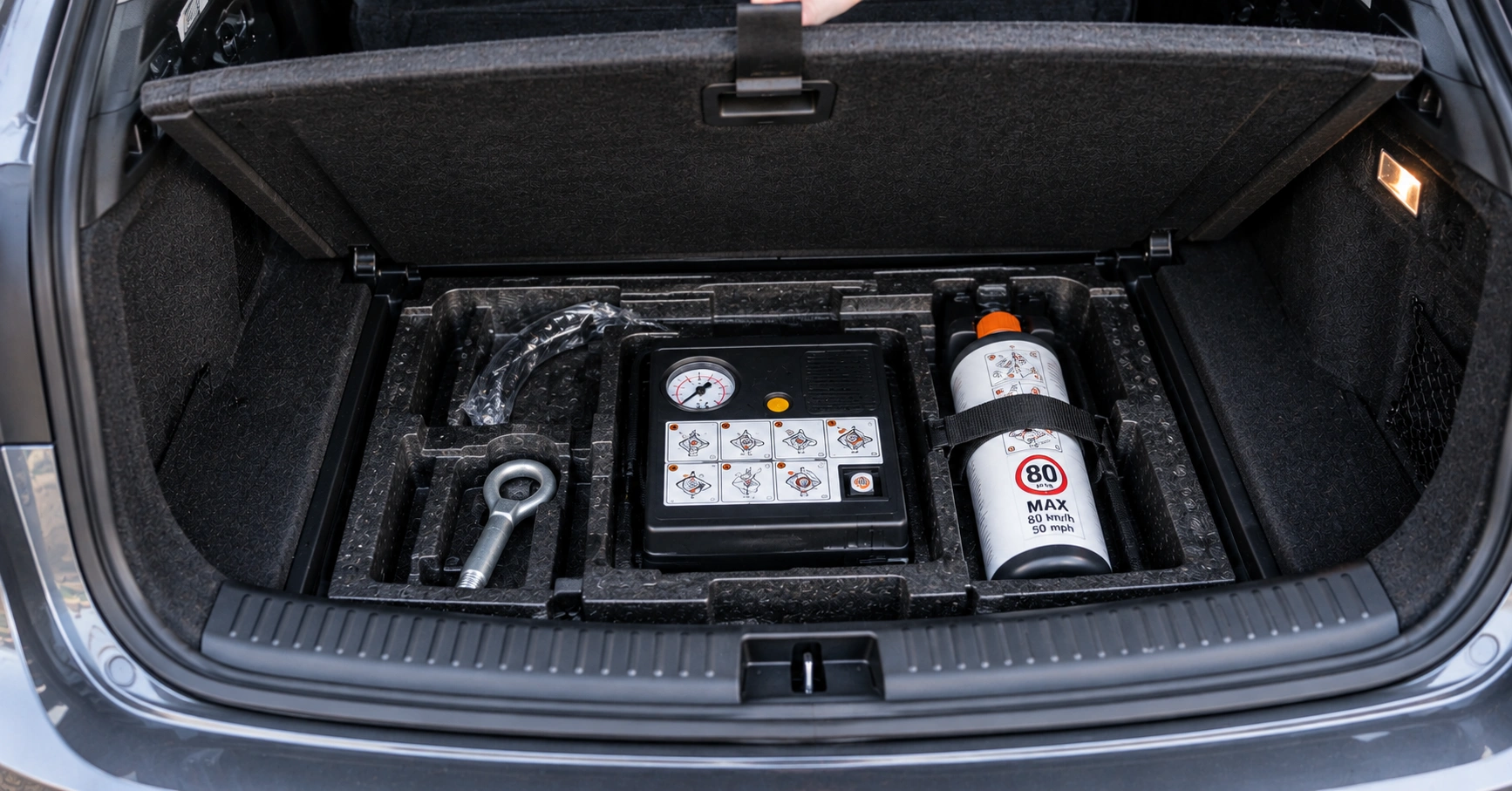
You open the boot after getting a puncture and discover there’s no spare wheel.
That’s normal on many modern cars. Manufacturers increasingly replace spare wheels with tyre sealant kits, run-flat tyres or simply leave drivers to arrange roadside assistance.
If your car has no spare, you generally have four options:
- Use the tyre sealant kit, if the damage is suitable
- Continue for a limited distance if you have run-flat tyres and the manufacturer allows it
- Call a mobile tyre fitter
- Call breakdown or recovery assistance
Which option is right depends on the type of damage, your location and the equipment supplied with your car.
Why Doesn’t My Car Have a Spare Wheel?
Removing the spare wheel reduces weight and frees up boot space. Some manufacturers instead provide:
- A tyre sealant and compressor kit
- Run-flat tyres
- An optional space-saver spare
- Roadside assistance arrangements
Don’t wait until you have a puncture to find out which setup your car has.
Check What Your Car Has
Open the boot and check under the floor.
Look for:
- A full-size or space-saver spare wheel
- A tyre sealant bottle
- A small air compressor
- A jack and wheel-removal tools
- Your locking wheel nut key
If you have sealant, check its expiry date.
If you have locking wheel nuts, make sure you know where the key is kept.
Your Options at a Glance
| Option | When It May Help | When It Won’t |
|---|---|---|
| Tyre sealant kit | Some small tread punctures | Sidewall damage, bulges, large cuts or serious tyre damage |
| Run-flat tyre | Limited travel after pressure loss if manufacturer permits | Not unlimited; damaged run-flats still need inspection/replacement |
| Mobile tyre fitter | Safe roadside, home, work or car park locations | Locations where there isn’t enough safe working space |
| Breakdown/recovery | Unsafe locations or where the vehicle needs moving | May recover the car rather than supply and fit a tyre |
Option 1: Use the Tyre Sealant Kit
Many cars without a spare wheel have a bottle of sealant and a small compressor.
The sealant is pushed into the tyre and the compressor reinflates it.
This can sometimes provide a temporary solution for a small puncture in the tread.
It isn’t a permanent repair.
Sealant generally isn’t suitable for:
- Sidewall cuts
- Sidewall punctures
- Tyre bulges
- Large holes
- A tyre that has come away from the wheel
- Serious structural damage
Before using it, read the instructions supplied with your vehicle and the sealant kit.
For more detail, see our guide to tyre sealant and puncture repair kits.
Option 2: Check Whether You Have Run-Flat Tyres
Some cars are fitted with run-flat tyres instead of a spare.
Run-flat tyres have reinforced sidewalls designed to support the vehicle for a limited distance after pressure is lost.
That doesn’t mean you can simply keep driving normally.
The permitted distance and maximum speed depend on the tyre and vehicle manufacturer, so check your handbook.
A run-flat tyre that has lost pressure still needs to be inspected.
Continuing too far can damage it beyond use.
Our guide on driving on a flat tyre explains why driving after pressure loss can cause additional damage.
Option 3: Call a Mobile Tyre Fitter
If the vehicle is somewhere safe and accessible, a mobile tyre fitter can come to the car rather than requiring you to drive it to a garage.
Depending on the damage, the tyre may be repairable or may need replacement.
Mobile assistance can be particularly useful when:
- The tyre is completely flat
- You don’t have a spare
- The sealant kit isn’t suitable
- You don’t want to risk further tyre or wheel damage by driving
- The vehicle is parked at home or work
- You’re in a suitable car park or safe roadside location
Before calling, have your tyre size, exact location and details of the damage ready.
See what to have ready before calling a mobile tyre fitter.
You can also view our mobile puncture repair and mobile tyre replacement services.
Option 4: Call Breakdown or Recovery Assistance
Breakdown assistance may be the better choice if:
- The car is in a dangerous location
- The vehicle needs to be moved before tyre work can take place
- There may be wheel or suspension damage
- The problem isn’t limited to the tyre
- A mobile fitter can’t safely work where the car is stopped
What breakdown cover provides depends on your policy.
Some services may fit your spare if you have one. If you don’t, they may recover the car rather than supply a replacement tyre.
See mobile tyre fitter vs breakdown cover vs garage for a fuller comparison.
What If You Get a Puncture on a Motorway?
Safety comes before the tyre.
If possible, leave the motorway at the next junction or service area.
If that isn’t possible, move into an emergency area or onto the hard shoulder where one is available.
Switch on your hazard lights and stop as far to the left as possible.
If it’s safe to leave the vehicle, exit using the left-hand doors and move behind a safety barrier.
Don’t attempt to change a wheel or carry out a tyre repair next to fast-moving motorway traffic.
If your vehicle is stopped in a live lane and you can’t safely get out, keep your seat belt on, switch on the hazard lights and call 999.
Should You Buy a Space-Saver Spare Wheel?
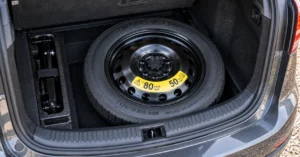
If your car doesn’t have a spare, you may be able to buy a compatible space-saver kit.
Before buying one, check:
- It fits your exact vehicle
- The wheel clears the brakes
- The tyre has the correct load capacity
- You have the correct jack
- You have the correct wheel wrench
- You have somewhere secure to store it
- You understand its speed and distance restrictions
A space-saver is intended as a temporary solution, not a normal replacement wheel.
Frequently Asked Questions
Why Do New Cars Often Have No Spare Tyre?
Removing the spare reduces vehicle weight and creates more storage space. Many manufacturers provide a sealant kit or fit run-flat tyres instead.
Can I Drive If I Don’t Have a Spare?
Having no spare isn’t what determines whether you can drive. The condition of the damaged tyre does. If the tyre is flat or unsafe, don’t continue simply because you don’t have another wheel available.
Can Tyre Sealant Fix Any Puncture?
No. Sealant is intended as a temporary measure for certain punctures and can’t repair sidewall damage, bulges, large cuts or serious structural damage.
Is a Run-Flat Tyre the Same as a Spare?
No. A run-flat tyre is designed to allow limited travel after pressure loss. It still has restrictions and must be inspected after being driven without normal pressure.
Can a Mobile Tyre Fitter Replace a Tyre If I Have No Spare?
Yes, provided the vehicle is in a safe and accessible location and the correct replacement tyre is available.
Need Help With a Puncture in Reading?
If you have no spare wheel and your car is safely parked, call 07415955827 with your tyre size and location ready.
For tyre-related assistance, see our mobile puncture repair and mobile tyre replacement services.