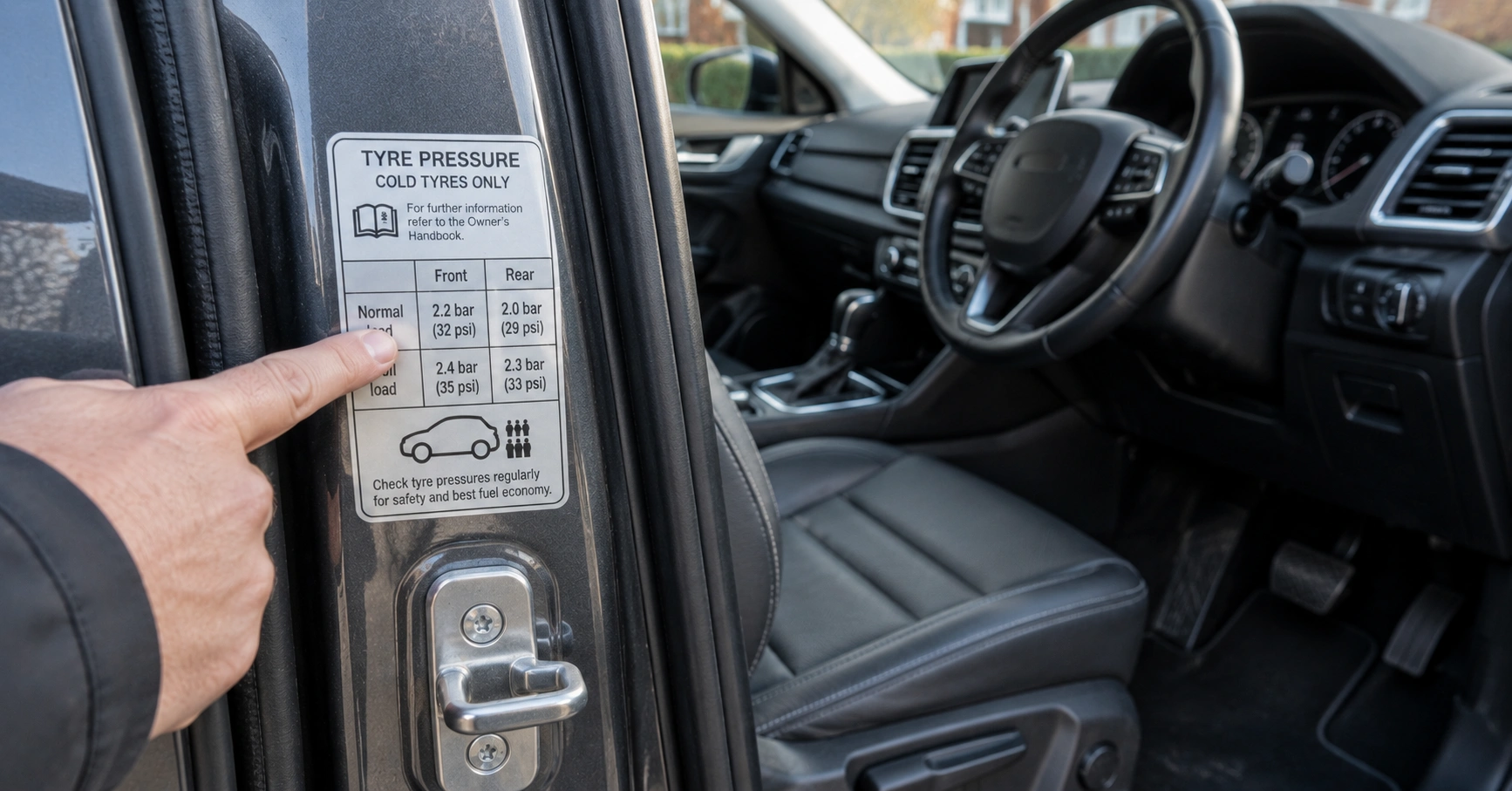
Your car’s correct tyre pressure is set by the vehicle manufacturer, not by the tyre or the wheel size. You’ll find it in one of three places:
- A sticker or metal plate in the driver’s door shut, on the door pillar
- Inside the fuel filler flap
- In the vehicle handbook
Check and set pressures when the tyres are cold, before you’ve driven far. Warm tyres read higher.
Two cars with the same wheel size can need very different pressures, because pressure depends on the weight of the car and how the manufacturer set it up. There’s no such thing as a correct pressure for “a 17-inch tyre”.
Where to look
The tyre information sticker
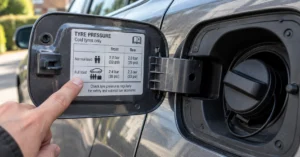
Most cars have a sticker showing the recommended pressures, usually as a small table. Common locations:
- Driver’s door shut, visible when the door is open
- Inside the fuel filler flap
- Occasionally inside the glovebox lid or on the boot lid
The sticker often lists more than one set of figures:
| What you may see | What it means |
|---|---|
| Normal, comfort or partial load | Everyday driving with one or two people |
| Full load, or with a number of occupants and luggage | A fully loaded car, or towing |
| Different front and rear figures | Many cars need a different pressure front and rear |
| Several tyre sizes listed | Find the row matching the size actually fitted to your car |
The handbook
If there’s no sticker, or it’s unreadable, the handbook has the same information, usually under wheels and tyres.
What is not a source of your car’s pressure
The number on the tyre sidewall near “MAX PRESS” is the tyre’s maximum limit, not a recommendation. Inflating to that figure would over-inflate most cars. See how to read a tyre sidewall.
PSI and bar
UK pressure figures are usually given in PSI (pounds per square inch), though many car stickers show bar, and some show both. Forecourt air machines vary.
| Bar | PSI (approximate) |
|---|---|
| 1.8 | 26 |
| 2.0 | 29 |
| 2.2 | 32 |
| 2.4 | 35 |
| 2.5 | 36 |
| 2.6 | 38 |
| 2.8 | 41 |
| 3.0 | 44 |
To convert: 1 bar is roughly 14.5 PSI. Use the units your car’s sticker uses wherever you can, rather than converting, to avoid rounding errors.
Cold tyres: why it matters
Driving heats the air inside a tyre, and warm air reads at a higher pressure. A tyre checked after a motorway run can read several PSI higher than the same tyre checked first thing in the morning.
Manufacturers’ figures are cold pressures. In practice:
- Check before you set off, or after the car has been parked for a few hours
- If you’ve driven more than a couple of miles to a garage, the reading will be raised. Set to the recommended figure anyway rather than trying to correct for the heat, and re-check when the tyres are cold.
- Don’t let air out of hot tyres to bring a high reading down to the recommended figure. They’ll be underinflated once cool.
Cold weather lowers pressure. A drop in outside temperature can be enough to trigger the warning light. See tyre pressure warning light.
When to use the “full load” figures
Use the higher figures when the car is carrying close to its maximum:
- a full car of passengers plus luggage
- a roof box or heavy roof load
- towing a trailer or caravan, where the towing pressures may differ again
- a van carrying a significant load
Underinflated tyres under a heavy load build up heat, which is one of the situations where a tyre is most likely to fail.
Remember to set them back to the normal figures when the car is empty again, otherwise the ride becomes harsh and the tread wears unevenly in the centre.
See our van tyres and load ratings guide for more on commercial tyre load requirements.
How to check pressures
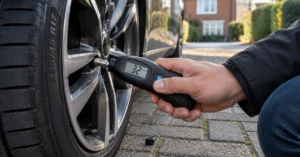
- Work when the tyres are cold.
- Unscrew the dust cap and keep it somewhere safe.
- Press the gauge squarely onto the valve. A short hiss is normal; a continuing hiss means it isn’t seated.
- Compare the reading with the figure for that axle.
- Inflate or release to the correct pressure.
- Refit the dust cap. It keeps dirt and water out of the valve.
- Check all four, and the spare if you have one.
Use a gauge you trust. Forecourt machines can be inaccurate, particularly at busy sites. A basic hand-held gauge is inexpensive and worth keeping in the car.
Check pressures regularly. Tyres lose a little air naturally over time, so they need topping up even when there’s nothing wrong.
See how often to check tyre pressure for a simple checking routine.
Why the right pressure matters
| Too low | Too high |
|---|---|
| Longer braking distances and vague steering | Reduced grip, particularly on uneven surfaces |
| More wear on the outer edges of the tread | More wear down the centre of the tread |
| More fuel used, or reduced range in an electric car | A harsher ride |
| Heat build-up, raising the risk of tyre failure | More vulnerable to impact damage from potholes |
Underinflation is the more common and more dangerous of the two, because it builds heat and can damage a tyre permanently.
See our uneven tyre wear patterns guide for what centre, edge and one-sided wear can indicate.
Pressures after new tyres or a repair
Whoever fits a tyre should set it to your car’s recommended pressure. It’s still worth checking within a few days.
Ask for the pressures used if your car has different front and rear figures, or if a space saver spare is fitted, since space savers usually need a considerably higher pressure. That figure is on the spare or in the handbook.
Frequently asked questions
What tyre pressure should my car be?
The figure set by your car’s manufacturer, which is on the sticker in the driver’s door shut or the fuel filler flap, or in the handbook. It varies by vehicle and by load, so there’s no single correct figure for a given wheel size.
Is the pressure on the tyre sidewall the one I should use?
No. The figure moulded into the sidewall is the tyre’s maximum, not a recommendation for your car. Use your vehicle’s own figures.
Should I check tyre pressures hot or cold?
Cold, before driving any distance. Manufacturers’ figures are cold pressures, and warm tyres read higher.
How much higher should tyre pressure be with a full load?
Use the loaded figures given on your car’s sticker or in the handbook rather than adding an arbitrary amount. Many cars specify a higher rear pressure when fully loaded.
Do tyres lose pressure on their own?
Yes. All tyres lose a small amount of air over time, and cold weather reduces pressure further. That’s normal, but a tyre that needs topping up every few days has a leak.
Tyre losing pressure faster than it should? If your car is somewhere safe, call 07415955827 about mobile puncture repair.