Introduction
A tyre blowout at 70mph is one of the most frightening things that can happen behind the wheel, and the M4 through Reading is one of the busiest stretches of road in the country to have it happen on. Add the A34 into the mix, and a huge number of local drivers are covering fast, heavily trafficked motorway miles every single day, often without giving their tyres a second thought until something goes wrong.
The good news is that a blowout is manageable if you know what to do in the first few seconds, and help is never far away. This guide walks through exactly how to recognise a blowout, how to bring your car to a stop safely, and what to expect once you’ve called for motorway tyre assistance. We’ll also cover how blowouts differ from a normal slow puncture, and the simple checks that reduce your risk of one happening in the first place.
Why Motorway Blowouts Are Different From a Normal Puncture
A slow puncture gives you warning. Tyre pressure drops gradually, sometimes over days, and you’ll often notice the car handling slightly differently before it becomes a real problem.
A blowout is the opposite. It’s sudden, loud, and total – the tyre fails all at once, usually while you’re still moving at speed. On a motorway, that combination of high speed and no warning is exactly what makes it dangerous, both for the driver and for other traffic around them.
Blowouts are also more common on motorways than other roads, for a few specific reasons:
- Sustained high speed generates far more heat in the tyre than town driving
- Long journeys mean any existing weakness in the tyre has more time and distance to fail
- Heavier loads – luggage, passengers, roof boxes – put extra strain on tyres already working hard at speed
Recognising the Warning Signs Before a Blowout
Very few blowouts happen with genuinely zero warning. In most cases, there are signs beforehand that are easy to miss if you’re not paying attention.
Watch and listen for:
- A rhythmic thumping or vibration through the steering wheel, which can indicate internal tyre damage
- A hissing sound, particularly at lower speeds or when stationary
- The car pulling gently to one side without you steering it there
- Visible bulges or bubbles on the sidewall during a pre-drive walk-round
If you notice any of these before setting off, it’s worth getting the tyre checked rather than hoping it holds. Our mobile tyre repair technicians can inspect a tyre at your home or workplace and tell you quickly whether it’s safe to drive on.
What to Do the Moment It Happens
If a blowout does happen while you’re driving, the instinct to react quickly is natural – but the right response is actually the opposite. Sudden movements make things worse, not better.
- Hold the steering wheel firmly and resist the urge to jerk it.
- Don’t brake hard. Ease off the accelerator gradually instead of stamping on the brake.
- Let the car slow down naturally as much as possible before you start steering toward the hard shoulder or a safe stopping point.
- Signal early so traffic behind you has time to react.
- Steer smoothly toward the verge, hard shoulder, or nearest safe refuge area once your speed has dropped.
The core idea is control, not speed. A blowout that’s handled calmly, with the car gradually brought under control, is far less dangerous than the blowout itself.
Getting to Safety on the M4 or A34
Once you’re safely off the live carriageway, your priority shifts to keeping yourself and your passengers safe until help arrives.
- Get out on the passenger side, away from moving traffic, wherever possible
- Move well behind the barrier, not just onto the hard shoulder itself
- Put on a hi-vis vest if you have one, especially at night or in poor visibility
- Switch on hazard lights immediately
For safety, our technicians coordinate hard shoulder call-outs with the relevant motorway recovery service before attending, since fitting a tyre on a live carriageway is not something that can be done safely without your vehicle first being moved to a proper refuge area.
What Not to Do After a Blowout
A few common instincts actually make the situation riskier rather than safer:
- Don’t try to drive further on a blown tyre, even slowly, to reach the next junction – this can damage the wheel rim and suspension, turning a tyre repair into a much bigger bill
- Don’t attempt to change the tyre on the hard shoulder yourself, particularly on a busy stretch like the M4 through Reading – it’s simply not worth the risk
- Don’t stand behind the vehicle while waiting for assistance
- Don’t ignore the vibration or noise beforehand, assuming it will sort itself out
Waiting for Help: What Happens Next
Once you’re in a safe position and have called for assistance, here’s roughly what to expect:
| Step | What Happens |
| 1. You call for help | Give your exact location – mile marker, junction numbers, or what3words if possible |
| 2. Recovery coordination | For hard shoulder or live-lane situations, your vehicle is moved to a safe refuge area first |
| 3. Technician dispatched | A mobile tyre fitter is sent to your location, typically within 20–30 minutes around Reading |
| 4. Assessment on arrival | The technician checks whether the tyre can be repaired or needs replacing |
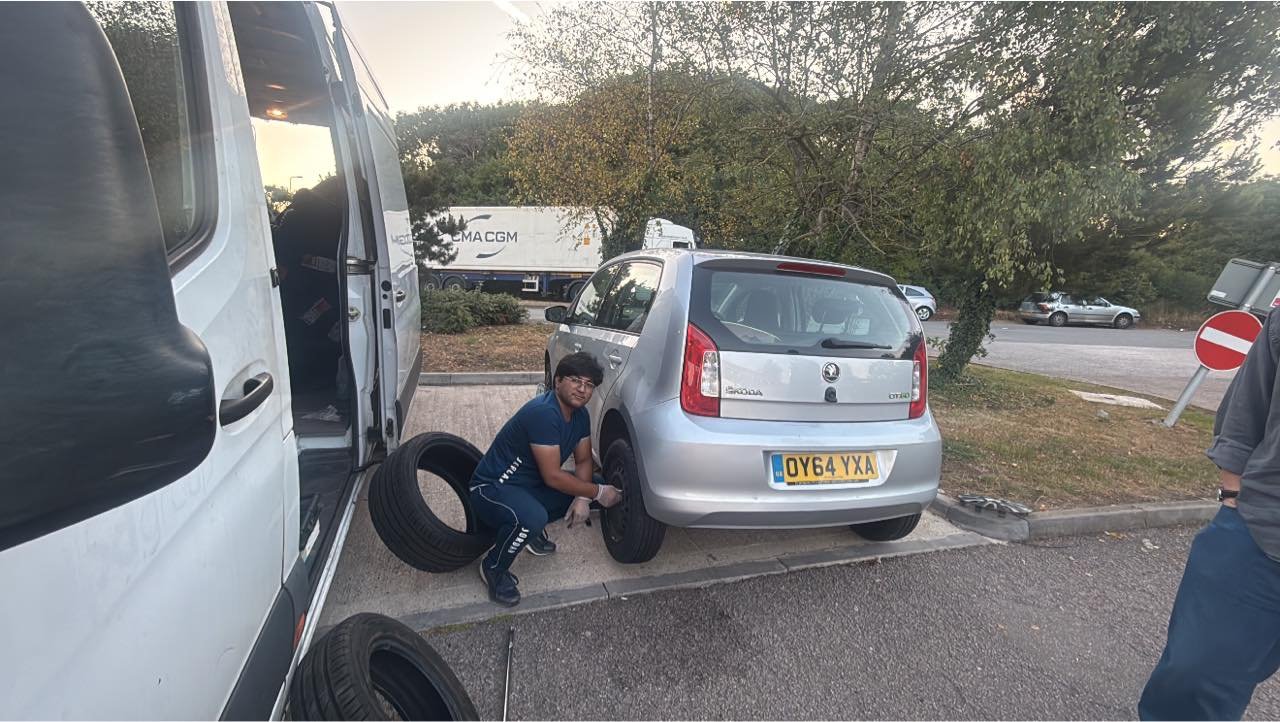
| 5. Fitting or repair | The job is carried out on-site, and you’re back on the road without needing a tow to a garage |
Blowout vs Slow Puncture: Key Differences
| Blowout | Slow Puncture | |
| Warning signs | Sudden, little to no warning | Gradual, pressure drops over time |
| Typical cause | Structural failure, heat, sidewall damage | Nail, screw, or small object |
| Risk level | High – happens at speed, sudden loss of control | Lower – usually manageable to a safe stop |
| Fix | Usually requires replacement | Often repairable if caught early |
| Best response | Controlled stop, avoid sudden braking | Pull over safely when convenient, get it checked |
How to Reduce Your Risk of a Blowout
Most blowouts are preventable with a bit of routine attention:
- Check tyre pressure regularly, including before any longer motorway journey, since underinflated tyres run hotter and are far more prone to failure
- Inspect sidewalls for bulges, cracking, or cuts as part of a normal walk-round
- Don’t overload the car. Roof boxes, heavy luggage, and a full complement of passengers all add strain
- Replace tyres before they’re dangerously worn, rather than waiting until the last possible moment
- Book a free tyre health check if you’re planning a longer motorway trip and haven’t had your tyres looked at recently
Motorway Tyre Assistance Around Reading
Mobile Tyre Doctor provides motorway tyre assistance across Reading and the surrounding area, including the M4 corridor through Chieveley, Membury, Heston, and Leigh Delamere, as well as the A34. We also cover Caversham, Woodley, Tilehurst, Earley, Wokingham, Bracknell, and further out toward Camberley, Fleet, and Farnham. Our free call-out covers a 5-mile radius of Reading, with a typical ETA of 20 to 30 minutes depending on where you’ve broken down.
FAQs
- Is it safe to keep driving after a blowout if I’m nearly at the next junction? No. Continuing to drive on a blown tyre, even slowly, risks damaging the wheel rim and suspension, and increases the chance of losing control. Get to a safe stop as soon as you reasonably can.
- What should I do if the blowout happens in a live lane rather than near the hard shoulder? Put your hazard lights on, keep your seatbelt on, and stay in the vehicle with your seatbelt fastened until it’s safe to move, or until recovery arrives to help guide you to safety. Never attempt to walk across live lanes.
- Can a blown tyre always be repaired, or does it need replacing? Most blowouts damage the tyre structure severely enough that replacement is needed rather than repair. A technician can confirm this on-site.
- How quickly can you reach me on the M4 near Reading? Our typical ETA is 20 to 30 minutes, depending on your exact location and current traffic conditions.
- Do you fit tyres directly on the hard shoulder? For safety, we coordinate with motorway recovery services to have your vehicle moved to a safe refuge area first, rather than fitting tyres on a live hard shoulder.
- What’s the difference between calling you and calling my breakdown cover? Breakdown cover often means waiting for a recovery truck and a trip to a garage. A mobile tyre fitting service like ours brings the tyre and the technician directly to you, which is usually faster if the fix is straightforward.
Conclusion
A tyre blowout on the M4 or A34 is unsettling, but it’s very manageable if you know the right steps: stay calm, avoid harsh braking, get to a safe position, and call for help rather than trying to fix things yourself on a live carriageway. Just as importantly, most blowouts give some warning beforehand – a vibration, a hiss, a visible bulge – and catching that early is the best way to avoid the situation altogether.
Regular tyre checks, sensible loading, and replacing tyres before they’re dangerously worn all go a long way toward keeping you off the hard shoulder in the first place.
Call to Action
If you’ve broken down on the M4, A34, or anywhere around Reading, contact Mobile Tyre Doctor for fast motorway tyre assistance. Call or WhatsApp 07415 955827 – available 24/7, with a typical ETA of 20 to 30 minutes and free call-out within a 5-mile radius of Reading.