Table of Contents
- Introduction
- What Is Wheel Balancing?
- Wheel Balancing vs Wheel Alignment: What’s the Difference?
- Signs Your Wheels Are Out of Balance
- Why Unbalanced Wheels Are a Safety Issue
- How Often Should You Get Your Wheels Balanced?
- What Causes Wheels to Go Out of Balance?
- Balanced vs Unbalanced Wheels: A Quick Comparison
- The Mobile Wheel Balancing Process
- FAQs
- Conclusion
- Call to Action
Introduction
If your steering wheel vibrates at certain speeds, or your car feels slightly “off” on the motorway, the culprit is often something drivers overlook entirely: wheel balance. Unlike a puncture or a warning light, an unbalanced wheel doesn’t always announce itself clearly, which means many drivers in Reading and Berkshire carry on for weeks without realising there’s an issue.
This guide explains what wheel balancing actually is, how it differs from wheel alignment, the warning signs to watch for, and how often you should have it checked to keep your car running smoothly and safely.
What Is Wheel Balancing?
Every wheel and tyre assembly has tiny variations in weight distribution around its circumference, caused by manufacturing tolerances in the tyre, wheel, and even the valve stem. Wheel balancing corrects this by attaching small weights to the wheel rim, evening out the mass so the wheel spins smoothly without wobbling.
Technicians use a wheel balancing machine to spin the wheel and detect exactly where the imbalance sits, then apply weights at the precise points needed to correct it.
Wheel Balancing vs Wheel Alignment: What’s the Difference?
These two services are often confused, but they solve different problems:
- Wheel balancing corrects uneven weight distribution within the wheel and tyre assembly, fixing vibration issues.
- Wheel alignment adjusts the angles of the wheels relative to each other and the road, fixing pulling and uneven tread wear.
A car can need one, both, or neither – vibration at speed typically points to a balancing issue, while a car pulling to one side usually points to alignment.
Signs Your Wheels Are Out of Balance
Unbalanced wheels tend to produce a fairly distinctive set of symptoms:
- Vibration in the steering wheel, usually most noticeable between 50-70mph.
- Vibration through the seat or floor, rather than the steering wheel, if the imbalance is on a rear wheel.
- Uneven or “cupped” tyre wear patterns, developing over time.
- A humming or thumping noise that changes with speed.
- Increased tyre wear on one specific tyre compared with the others.
Why Unbalanced Wheels Are a Safety Issue
Beyond the discomfort of a vibrating steering wheel, unbalanced wheels place uneven stress on suspension components, wheel bearings, and the tyres themselves. Over time, this can accelerate wear on parts that are far more expensive to replace than a simple balancing job. At higher speeds, a significant imbalance can also make the car feel less predictable and harder to control, particularly during sudden manoeuvres.
How Often Should You Get Your Wheels Balanced?
As a general guide, wheels should be checked and balanced:
- Whenever you fit new tyres
- Roughly every 6,000-10,000 miles as part of routine maintenance
- Immediately if you notice vibration, unusual noise, or uneven wear
- After hitting a significant pothole or kerb
Regular balancing checks help catch small imbalances before they cause uneven tyre wear or additional strain on your suspension.
What Causes Wheels to Go Out of Balance?
Wheel imbalance doesn’t usually happen suddenly without cause. Common triggers include:
- Normal wear from everyday driving over time
- Hitting potholes, kerbs, or speed bumps at speed
- Loss of a wheel weight due to age or road debris
- Uneven tyre wear that develops gradually
- Fitting a new tyre without a proper balancing check afterwards
Balanced vs Unbalanced Wheels: A Quick Comparison
| Factor | Balanced Wheels | Unbalanced Wheels |
| Ride comfort | Smooth, no vibration | Noticeable vibration at speed |
| Tyre wear | Even wear across the tread | Cupped or patchy wear patterns |
| Suspension strain | Minimal | Increased over time |
| Fuel efficiency | Consistent | Can be slightly reduced |
| Driving confidence | Stable and predictable | Can feel unsettled at higher speeds |
| Long-term cost | Lower, prevents extra wear | Higher, accelerates part replacement |
The Mobile Wheel Balancing Process
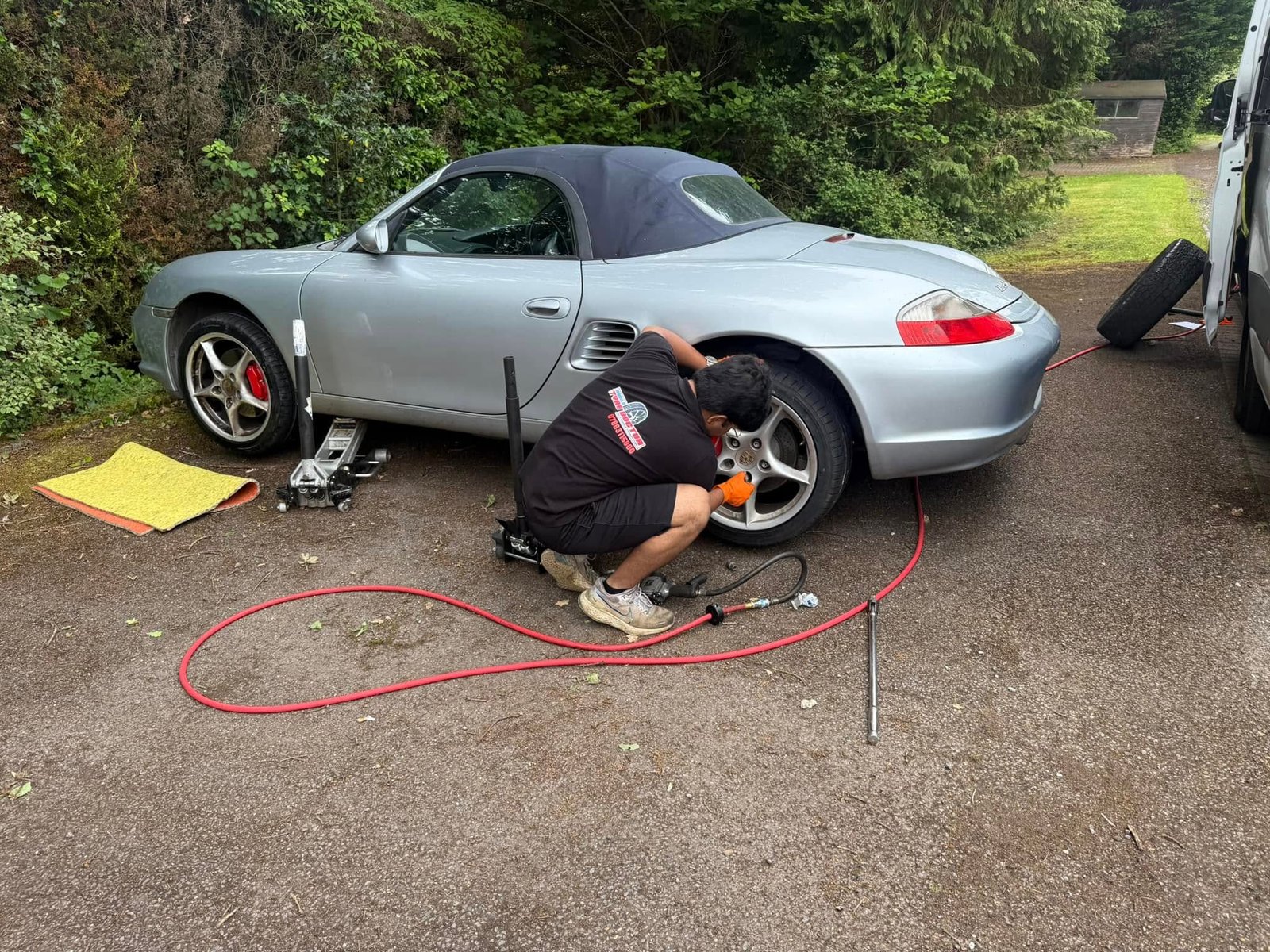
A mobile wheel balancing appointment is straightforward. The technician removes each wheel, mounts it on a balancing machine, and identifies the exact point of imbalance. Small weights are then fitted to the rim to correct it, and the wheel is refitted and re-checked to confirm the issue is resolved. As part of a full mobile tyre fitting or tyre replacement appointment, balancing is often carried out as standard, since a new tyre changes the overall weight distribution of the wheel assembly.
FAQs
- How do I know if I need wheel balancing or wheel alignment? Vibration through the steering wheel, especially at motorway speeds, usually points to a balancing issue. If your car pulls to one side or you notice uneven tread wear across the tyre’s width, alignment is more likely the cause.
- Does wheel balancing improve fuel economy? It can help slightly, as a balanced wheel rolls more efficiently and places less strain on the drivetrain, though the effect is generally modest compared with correct tyre pressure.
- How long does wheel balancing take? A typical wheel balancing job takes around 15-20 minutes per wheel, though this can vary depending on the vehicle and the extent of the imbalance.
- Can I drive with an unbalanced wheel? It’s not immediately dangerous in most cases, but continuing to drive on an unbalanced wheel accelerates tyre wear and puts extra strain on your suspension, so it’s best addressed promptly.
- Do all four wheels need balancing at once? Not necessarily – a technician can identify which specific wheel is causing the imbalance. However, it’s often practical to check all four during a routine service.
- Will new tyres automatically be balanced? Reputable fitters balance new tyres as standard practice, but it’s always worth confirming this is included when booking a fitting appointment.
Conclusion
Wheel balancing is a small, often overlooked service that has a real impact on ride comfort, tyre longevity, and overall driving safety. If you’ve noticed vibration at speed or unusual tyre wear, it’s a quick and affordable fix that can prevent bigger, costlier problems down the line.
Call to Action
Noticed vibration or uneven wear on your tyres? Book a mobile wheel balancing appointment with Mobile Tyre Fitting Reading and get it sorted at your home, workplace, or roadside location.