Table of Contents
- Introduction
- Why Motorway Tyre Failures Are Especially Dangerous
- Immediate Steps If You Suspect a Tyre Problem
- Using the Hard Shoulder Safely
- What to Do If There’s No Hard Shoulder (Smart Motorways)
- Contacting Help: Who to Call and What to Say
- Hard Shoulder vs Smart Motorway: Key Differences
- Common Causes of Motorway Tyre Blowouts
- How Mobile Tyre Assistance Works on Motorways
- FAQs
- Conclusion
- Call to Action
Introduction
A tyre problem on a quiet residential street is stressful enough – the same issue on the M4 or A34 at 70mph is a genuinely dangerous situation. High speeds, fast-moving traffic, and limited space to manoeuvre mean motorway tyre failures require a very different response to a flat tyre at home.
This guide walks through exactly what to do if you suspect a tyre problem on a motorway, how to stay safe while waiting for help, and how mobile tyre assistance works for drivers travelling through Reading and the surrounding motorway network.
Why Motorway Tyre Failures Are Especially Dangerous
At motorway speeds, a sudden loss of tyre pressure – whether from a blowout or a fast puncture – can cause a vehicle to pull sharply to one side, making it difficult to control. Combined with high-speed traffic passing within metres of a stopped vehicle, the risk isn’t just mechanical; it’s a genuine safety hazard for both the driver and other road users.
Immediate Steps If You Suspect a Tyre Problem
If you notice symptoms of a tyre issue while driving – vibration, pulling to one side, or an unusual noise – act calmly and deliberately:
- Don’t brake harshly. Sudden braking can worsen loss of control, especially with a rapidly deflating tyre.
- Ease off the accelerator gradually and allow the car to slow naturally.
- Signal early and move toward the hard shoulder or nearest safe exit point.
- Keep steering steady, resisting the urge to overcorrect if the car pulls to one side.
- Come to a stop as far left as possible, ideally well onto the hard shoulder where one exists.
Using the Hard Shoulder Safely
Once safely stopped on a traditional hard shoulder:
- Turn on your hazard warning lights immediately.
- Exit the vehicle from the passenger side, away from moving traffic, if it’s safe to do so.
- Move behind the safety barrier if one is present, well away from the vehicle and carriageway.
- Do not attempt to change the tyre yourself on a live hard shoulder – this is a well-known cause of serious motorway accidents.
- Call for assistance and wait in a safe position until help arrives.
What to Do If There’s No Hard Shoulder (Smart Motorways)
Sections of the M4 and other UK motorways now operate as “smart motorways,” where the hard shoulder is sometimes used as a running lane and only Emergency Refuge Areas (ERAs) are available for stopping.
- If you feel a tyre problem developing, try to reach the nearest ERA (marked with orange signage roughly every 1.5 miles) if you can do so safely.
- If you cannot reach an ERA and must stop in a live lane, keep hazard lights on, keep seatbelts fastened, and call 999 immediately – this is treated as an emergency.
- Do not attempt to exit the vehicle in a live lane unless remaining inside poses an immediate danger.
Contacting Help: Who to Call and What to Say
Once safely stopped, contact for help promptly:
- Highways England / National Highways can be reached to report your location and situation.
- A mobile tyre assistance service can attend your exact location on many motorway sections, avoiding the need for a full recovery truck in many cases.
- Clearly state your location using the nearest marker post (small blue signs with numbers found along the hard shoulder), which helps responders find you quickly.
- Mention whether you are on a hard shoulder or in an Emergency Refuge Area, as this affects how responders approach your vehicle.
Hard Shoulder vs Smart Motorway: Key Differences
| Factor | Traditional Hard Shoulder | Smart Motorway (No Hard Shoulder) |
| Stopping option | Available along the full route | Only at Emergency Refuge Areas |
| Spacing of refuge points | Continuous | Roughly every 1.5 miles |
| Risk level if stopped | Lower, dedicated stopping lane | Higher, may be in a live lane |
| Recommended action | Move fully onto shoulder, exit safely | Reach nearest ERA if possible; call 999 if stuck in-lane |
| Camera monitoring | Standard motorway cameras | Stopped vehicle detection technology |
Common Causes of Motorway Tyre Blowouts
Understanding common causes can help you reduce your risk before setting off:
- Underinflated tyres generating excessive heat at sustained high speed
- Existing tread damage or a slow puncture that worsens under motorway conditions
- Overloaded vehicles placing extra strain on tyres
- Ageing tyres with degraded sidewalls, even if tread depth appears adequate
- Sudden impacts with potholes or debris at speed
A quick tyre pressure and condition check before a long motorway journey significantly reduces the risk of a blowout occurring in the first place.
How Mobile Tyre Assistance Works on Motorways
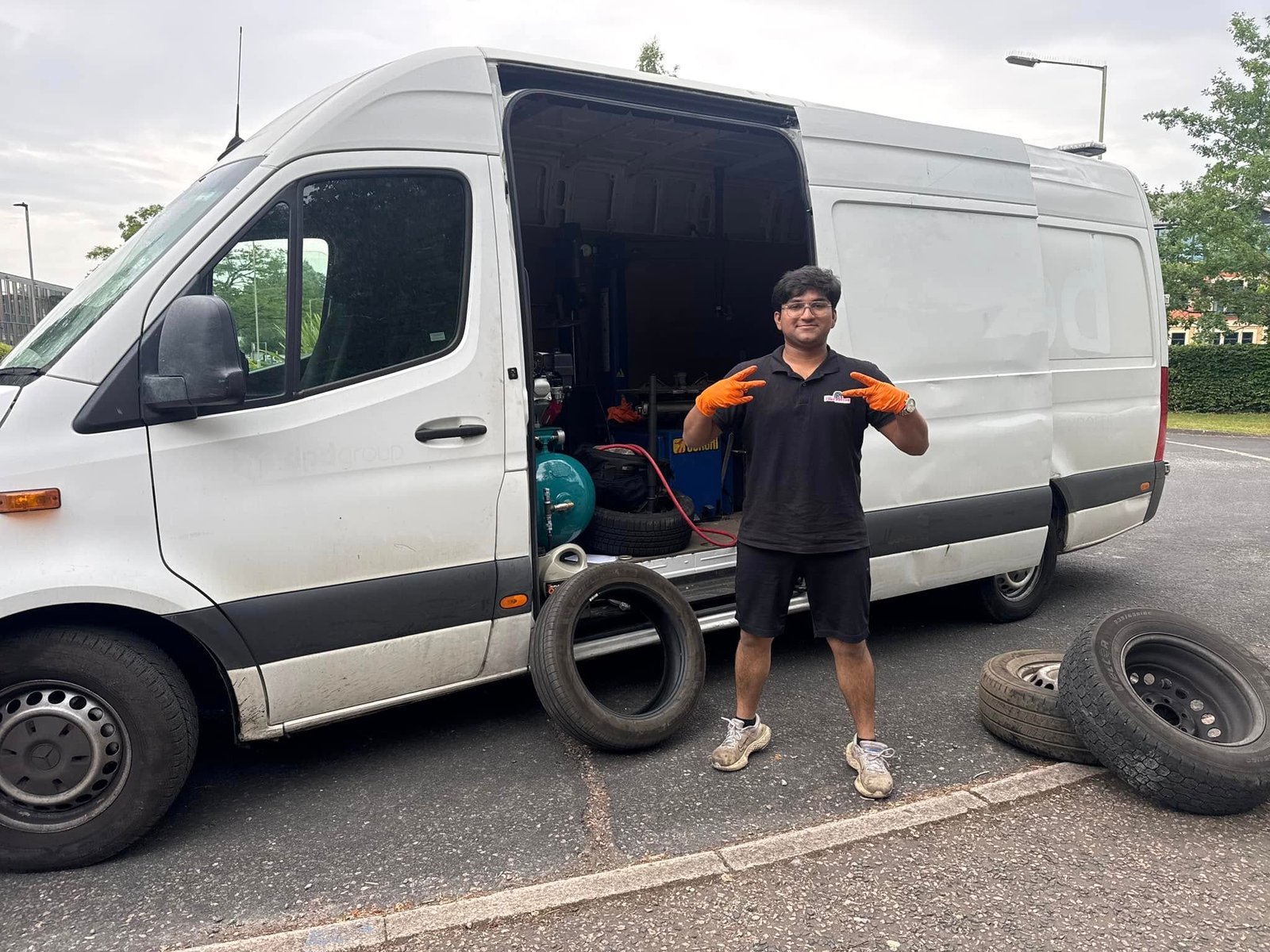
Mobile tyre assistance is designed specifically for situations like this. Once you’re safely stopped in an appropriate location, a technician can attend with the tools and tyres needed to carry out an on-site repair or replacement, often avoiding the need for a full recovery vehicle. This is particularly valuable on routes like the M4 and A34, where motorway tyre assistance can get you back on the road quickly and safely, without the added cost and delay of a garage tow.
FAQs
- Should I try to change a tyre myself on the hard shoulder? No. Changing a tyre on a live hard shoulder is extremely dangerous due to passing traffic, and it’s strongly advised against. Wait in a safe position and call for assistance instead.
- What is an Emergency Refuge Area? It’s a designated stopping bay found on smart motorways without a permanent hard shoulder, marked with orange signage and spaced roughly every 1.5 miles.
- What should I do if I can’t reach a refuge area in time? If you’re forced to stop in a live lane, keep your hazard lights on, keep your seatbelt fastened, and call 999 immediately to report your exact location.
- How do I know my exact location on the motorway? Look for small blue marker posts along the hard shoulder or verge, which display a number that responders can use to pinpoint your location precisely.
- Can mobile tyre assistance reach me directly on the motorway? In many cases, yes, particularly once you’re safely stopped on a hard shoulder or in a refuge area. Always confirm your exact location and situation when calling for help.
- What’s the safest place to wait for help on a motorway? Behind the safety barrier, well away from the carriageway and your vehicle, is the safest position while waiting for assistance to arrive.
Conclusion
A tyre problem on the motorway is one of the more stressful situations a driver can face, but staying calm, following clear safety steps, and knowing your exact location can make a significant difference. Whether you’re travelling the M4, A34, or another local route through Reading and Berkshire, knowing what to do in advance is one of the best ways to stay safe.
Call to Action
Need fast, reliable tyre assistance on the motorway or roadside? Contact Mobile Tyre Fitting Reading for 24/7 emergency call-outs covering the M4, A34, and surrounding routes.