A mobile tyre fitter can usually give you a much more accurate answer if you have four things ready:
- Your exact location
- Your tyre size
- A clear description of what happened
- Your locking wheel nut key, if your car uses one
A few minutes checking these before you call can save time and help the fitter bring the right tyre and equipment.
Quick Checklist
| What to Have Ready | Why It Matters |
|---|---|
| Exact location | Helps the fitter find you and assess access |
| Full tyre size | Makes sure the correct replacement tyre is brought |
| Description of the damage | Helps assess whether repair or replacement may be needed |
| Photo of the tyre/damage | Can help clarify what has happened |
| Locking wheel nut key | May be needed to remove the wheel |
| Safe working space | A fitter needs enough room to work safely around the vehicle |
| Details of sealant use | Sealant can affect what needs to happen next |
1. Your Exact Location
“Somewhere in Reading” isn’t enough when a fitter is trying to reach a stranded vehicle.
Give the most precise location you can.
At Home
Provide:
- Street name
- House number
- Postcode
- Where the vehicle is parked
At Work
Provide:
- Business or building name
- Full address and postcode
- Which car park or entrance the vehicle is near
- Any access instructions
In a Car Park
Give:
- Name of the car park
- Level or floor
- Row, bay or nearby landmark
- Vehicle registration and colour if useful for finding it
At the Roadside
Give:
- Road name or number
- Direction of travel
- Nearby junction or landmark
- Your safest accessible location
The fitter also needs to know whether there’s enough space to work around the affected wheel.
2. Your Full Tyre Size
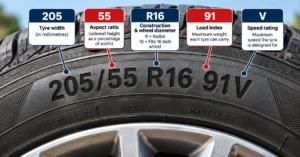
The tyre size is printed on the sidewall.
It looks something like:
205/55 R16 91V
| Part | Example | What It Means |
|---|---|---|
| Width | 205 | Tyre width in millimetres |
| Profile | 55 | Sidewall height as a percentage of width |
| Construction | R | Radial construction |
| Rim diameter | 16 | Wheel diameter in inches |
| Load index | 91 | Maximum load rating |
| Speed rating | V | Maximum speed rating |
Don’t just say, “I need a 16-inch tyre.”
There are many different widths, profiles, load ratings and speed ratings that fit a 16-inch wheel.
If you’re unsure, take a clear photo of the sidewall showing the complete code.
Our guide on how to read a tyre sidewall explains the size, load rating, speed rating and other markings.
Also mention if you can see markings such as:
- RFT or another run-flat marking
- XL or Reinforced
- Manufacturer-specific markings
These can affect which replacement tyre is suitable.
3. Explain What Happened
The more accurately you describe the problem, the better prepared the fitter can be.
Useful details include:
- Is there a nail or screw in the tyre?
- Is there visible sidewall damage?
- Did you hear a bang while driving?
- Is it a slow pressure loss?
- Is the tyre completely flat?
- Have you driven on the tyre while it was flat?
- Have you used tyre sealant or a puncture repair kit?
If you can see a nail or screw, don’t pull it out. Read our guide on what to do with a nail or screw in your tyre.
If you’ve already driven on the tyre after it lost its pressure, tell the fitter. Our guide on driving on a flat tyre explains why this matters.
If you’ve used a sealant kit, mention that as well. See what tyre sealant and puncture repair kits can and can’t fix.
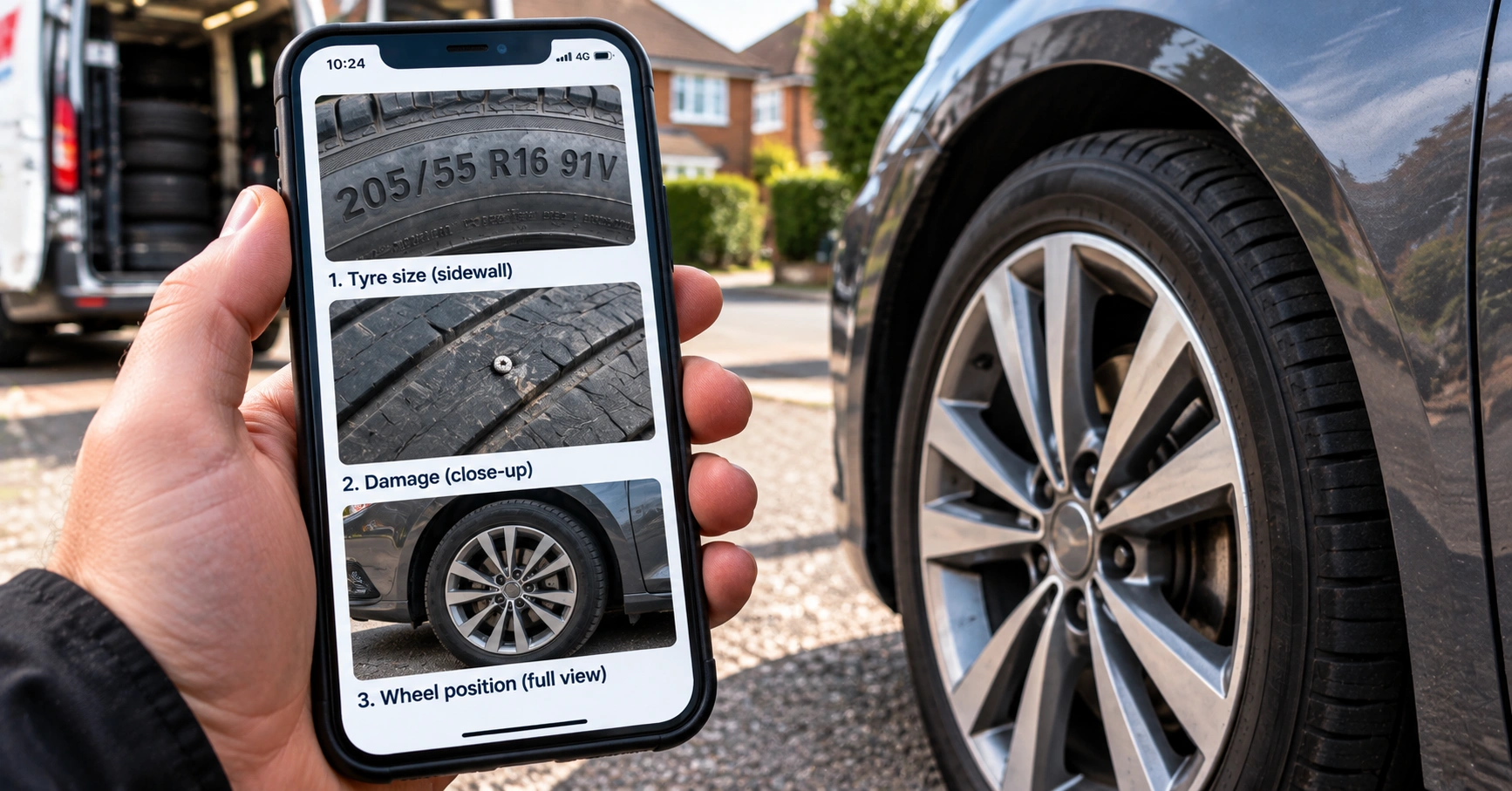
Take Photos If You Can
Useful photos include:
- The complete tyre sidewall showing the size
- The visible puncture
- Any sidewall cut, bulge or damage
- The wheel and tyre from a little further back
- Your location if access may be difficult
A photo doesn’t replace a physical tyre inspection, but it can make the initial conversation much clearer.
4. Find Your Locking Wheel Nut Key
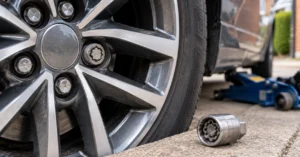
Many cars have one locking wheel nut or bolt on each wheel.
The key is a small adaptor that fits the locking nut and allows it to be removed.
Common places to check include:
- Glovebox
- Spare wheel compartment
- Boot side storage
- Under the boot floor
- With the jack or tyre tools
- Centre console
- A small box or pouch supplied with the car
If you can’t find the locking wheel nut key, tell the fitter before they travel to you.
Don’t wait until the wheel needs to come off to mention it.
5. Check There Is a Safe Place to Work
A mobile fitter needs enough safe space around the affected wheel.
| Location | Usually Suitable? |
|---|---|
| Private driveway | Yes, if there is enough room |
| Quiet residential parking | Usually |
| Open car park | Usually |
| Workplace car park | Usually, subject to access |
| Multi-storey car park | Depends on access and working space |
| Narrow busy road | May not be safe |
| Motorway hard shoulder | Not a normal roadside fitting location |
If you’re on a motorway or in another dangerous location, your immediate priority is safety rather than tyre fitting.
Read mobile tyre fitter vs breakdown cover vs garage to understand when recovery assistance may be more appropriate.
If possible, move the vehicle to a safer nearby location only if it can be done safely and without driving on a damaged flat tyre.
What Happens When the Fitter Arrives?
The exact process depends on the problem, but a tyre job will normally involve checking the tyre and wheel before deciding whether the tyre can be safely repaired or needs replacement.
For a puncture, the outside appearance isn’t enough to confirm that a repair is safe.
The tyre may need to be removed from the wheel so the inside can be inspected for hidden damage.
A puncture repair should only be carried out when the damage falls within the permitted repair area and the tyre is otherwise suitable for repair.
Why It Matters Whether You’ve Driven on the Flat
A tyre can look repairable from the outside but be badly damaged inside after being driven with little or no air pressure.
The weight of the vehicle crushes the sidewall between the wheel and the road.
That can damage the internal structure of the tyre.
Always tell the fitter if you’ve:
- Driven after the warning light came on
- Driven while the tyre looked visibly low
- Continued after the tyre became completely flat
- Driven any significant distance with no pressure
This information helps explain what the fitter needs to inspect.
Frequently Asked Questions
Can I Just Send a Photo of My Tyre Size?
Yes. A clear photo of the sidewall showing the complete size code can be easier and more accurate than reading the numbers over the phone.
What If I Don’t Know Whether the Tyre Can Be Repaired?
That’s fine. Describe what happened and where the visible damage is. The final repair decision normally requires a physical inspection.
What If the Car Is in a Car Park?
Give the name of the car park, level, bay or row and any height or access restrictions you know about.
Should I Remove a Nail Before the Fitter Arrives?
No. Leave the nail or screw in place. Removing it can make the tyre lose air faster.
What If I Have Used Tyre Sealant?
Tell the fitter before they start work. Sealant can affect the inspection and what needs to be done next.
Need a Mobile Tyre Fitter in Reading?
Before calling, have your location, tyre size and a description of the problem ready.
Call 07415955827 for mobile tyre assistance.
You can also use our contact page to get in touch.