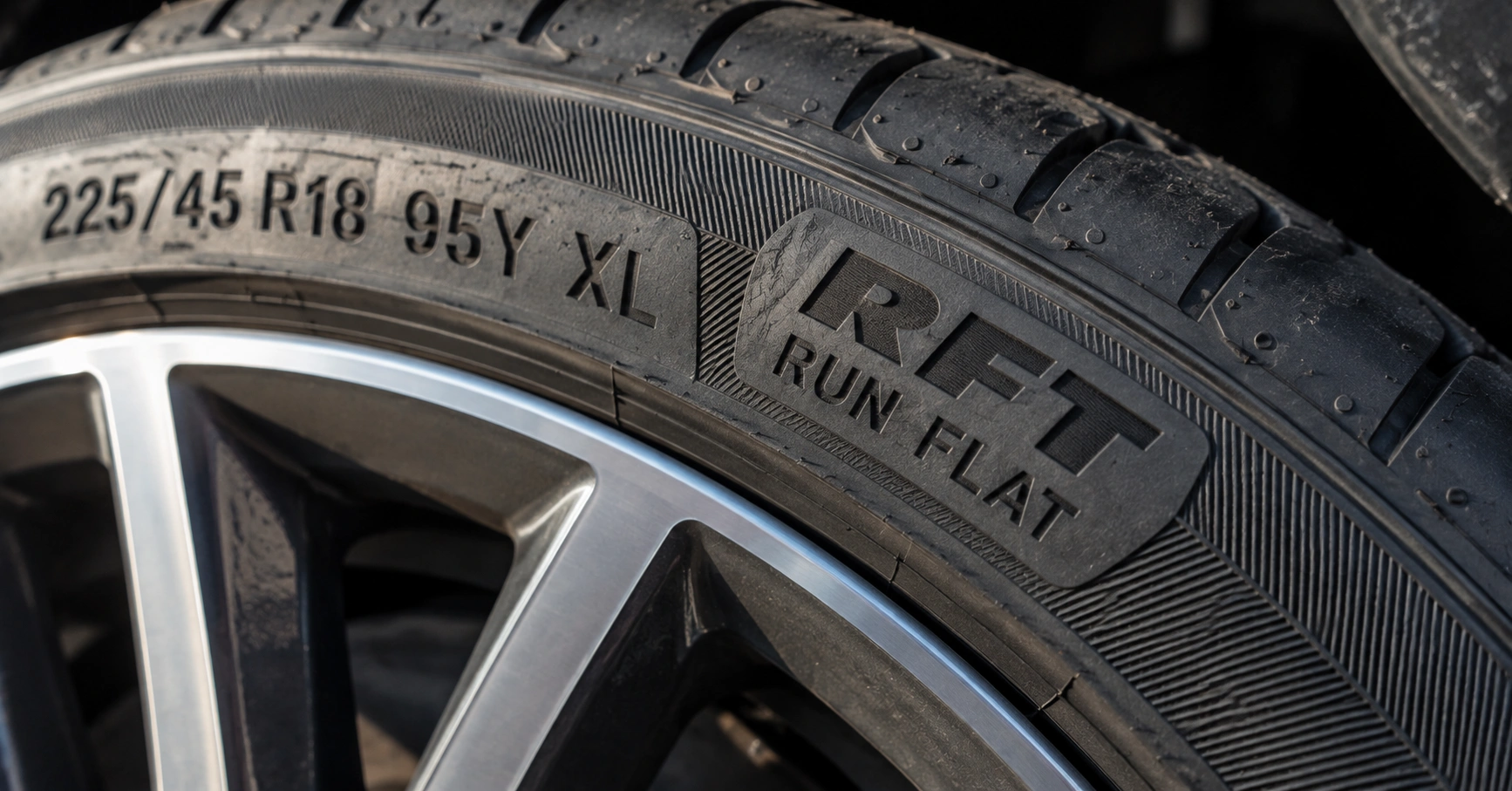
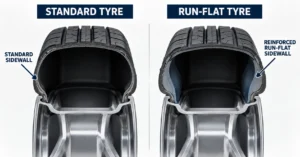
Run-flat tyres have reinforced sidewalls that can carry the car’s weight for a limited distance after the tyre loses air. They’re designed to get you to a safe place, not to keep you going.
If your tyre pressure warning comes on and you have run-flats:
- Slow down and stay within the speed limit in your handbook for running on a deflated run-flat.
- Drive only as far as the handbook allows, and ideally less.
- Get the tyre inspected as soon as you can.
A run-flat that has been driven on while deflated often can’t be repaired, and many tyre manufacturers don’t approve repairs to run-flats at all. Expect a replacement.
How to tell whether you have run-flats
Check the tyre sidewall for a marking. Every manufacturer uses its own, so look for any of these:
| Marking | Used by |
|---|---|
| RFT | Bridgestone and others |
| RunOnFlat / ROF | Goodyear, Dunlop |
| SSR | Continental |
| ZP / ZPS (“zero pressure”) | Michelin, Pirelli |
| EMT (“extended mobility”) | Goodyear |
| DSST | Dunlop |
| Run Flat / RF | Various |
Other clues:
- Your car has no spare wheel and no sealant kit. Many manufacturers leave both out when run-flats are fitted, because the tyre itself is the get-you-home measure.
- The handbook has a run-flat section setting out speed and distance limits.
- The car has a tyre pressure monitoring system. Run-flats are normally fitted alongside one, because a deflated run-flat can feel almost normal to drive.
If you’re not sure, check the handbook or ask a tyre fitter. It matters, because the right response to a puncture is different.
Why the pressure warning light is so important
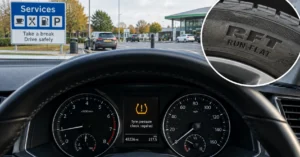
A standard tyre going flat is obvious. The car pulls, the steering feels heavy, and you can hear it.
A run-flat losing air often isn’t. The reinforced sidewall holds the tyre’s shape, so the car can feel much the same for a while. The warning light may be the only sign that anything is wrong.
That’s why you shouldn’t ignore the light on a car with run-flats, and why a working monitoring system matters. See tyre pressure warning light.
How far and how fast?
Use the limits in your vehicle handbook. They vary by car and by tyre, which is why a single figure quoted online isn’t reliable for your vehicle.
What to do in practice:
- Reduce speed straight away. The limit for running deflated is usually far below normal road speeds.
- Avoid hard braking, sharp steering and potholes. The tyre is working well outside its normal operating condition.
- Plan the shortest sensible route to somewhere safe where the car can be looked at.
- Treat the distance as a maximum, not a target. The further you drive, the more damage accumulates.
If the tyre is badly damaged, not simply deflated, for example a large cut, a blowout or a tyre that’s come off the rim, the run-flat capability doesn’t apply. Stop and get help.
Can a run-flat be repaired?
Often not. Several factors stack against it:
- Many tyre manufacturers don’t approve repairs to run-flats, because damage caused by running deflated is difficult to assess from the inside.
- The same British Standard rules apply as for any tyre. A repair is only possible for damage in the central tread area, under 6mm, with no other damage. Damage from running deflated is a specific reason a tyre can’t be repaired.
- Any repair has to be judged after the tyre is removed from the wheel and inspected internally.
So the honest answer is: it depends on the tyre manufacturer’s policy and what the internal inspection shows, and replacement is the more likely outcome. Anyone who tells you over the phone that your run-flat can definitely be repaired is guessing.
For the general rules, see what to do with a nail in your tyre.
Run-flats and sealant kits
A sealant kit isn’t the answer for a run-flat. If your car came with run-flats, it probably didn’t come with a kit. Even if you carry one, sealant won’t address damage caused by running the tyre deflated, and it makes the internal inspection harder.
See what tyre sealant kits can and can’t fix.
Replacing run-flats: keep them or switch?
When one run-flat needs replacing, you have two choices.
Replace like for like
The straightforward option. Your car keeps the handling the manufacturer set it up for, and you keep the get-you-home capability.
Run-flats generally cost more than standard tyres of the same size.
Switch to standard tyres
Possible on many cars, but think it through first:
| Consider | Why |
|---|---|
| You’ll have no way of dealing with a puncture | No spare, no kit and no run-flat means being stranded. You’d need to carry a sealant kit or arrange a mobile fitter. |
| Don’t mix run-flats and standard tyres on the same axle | They behave differently under load. Manufacturers generally advise against mixing them at all on a car. |
| Ride and handling change | Some drivers find standard tyres more comfortable; others notice a change in steering feel. |
| Your monitoring system still matters | It’s your main warning of a slow puncture either way. |
| Check your handbook and insurer | Some manufacturers specify run-flats for the vehicle. |
Switching usually means replacing all four, not one, and thinking about what you’d do about a puncture afterwards. See no spare wheel? Your options after a puncture and replace one, two or four tyres?
If it happens on a motorway
Run-flat capability doesn’t change the safety advice. Being able to keep moving may help you reach an exit, but the priority is getting off the carriageway.
- Leave at the next exit or services if you can, at reduced speed.
- If you can’t, stop as far left as possible in an emergency area or on the hard shoulder.
- Get out by the left-hand doors if it’s safe and wait behind the barrier.
- Call for help. National Highways can be reached on 0300 123 5000.
- If you’re stuck in a live lane or can’t get out safely, stay belted in with hazard lights on and call 999.
What to tell a tyre fitter
- That the car has run-flats, and the marking on the sidewall
- The full tyre size code, including any XL marking and the speed rating
- How far you drove after the warning light came on, and roughly how fast
- Whether there’s visible damage, and where on the tyre
- Whether your car has a spare (most run-flat cars don’t)
Our checklist before calling a mobile tyre fitter covers the rest, and how to read a tyre sidewall explains the size code.
Frequently asked questions
How far can you drive on a run-flat tyre with a puncture?
Only as far as your vehicle handbook allows, at or below the speed it specifies. The limits vary between cars and tyres, so use your own handbook rather than a general figure, and treat it as a maximum.
Can run-flat tyres be repaired?
Often not. Many tyre manufacturers don’t approve repairs to run-flats, and a tyre that has been driven while deflated usually can’t be repaired safely under the British Standard. It can only be judged once the tyre is off the wheel and inspected inside.
How do I know if my car has run-flat tyres?
Look for markings on the sidewall such as RFT, ROF, SSR, ZP or “Run Flat”. A car with no spare wheel and no sealant kit is another strong clue. The handbook will confirm it.
Can I replace run-flats with normal tyres?
On many cars, yes, but check the handbook first. You’d lose the run-flat capability without gaining a spare, so plan how you’d deal with a puncture. Don’t mix run-flats and standard tyres on the same axle.
Why didn’t I notice my run-flat was flat?
The reinforced sidewall holds the tyre’s shape, so a deflated run-flat can feel close to normal at first. The tyre pressure warning light is often the only early sign, which is why it shouldn’t be ignored.
Run-flat warning light on and parked somewhere safe? Call 07415955827 with your tyre size. We can look at mobile tyre replacement at your location.